Islay, Orkney, the Mainland
Peat Cutting & Bogs
Not every bog smells the same. Cutting peat means lifting out a slice of the landscape and climate of its region, from the salty coast of Islay to the windswept bogs of Orkney. Place shapes the smoke far more than any recipe ever could.
How Peat Cutting Works
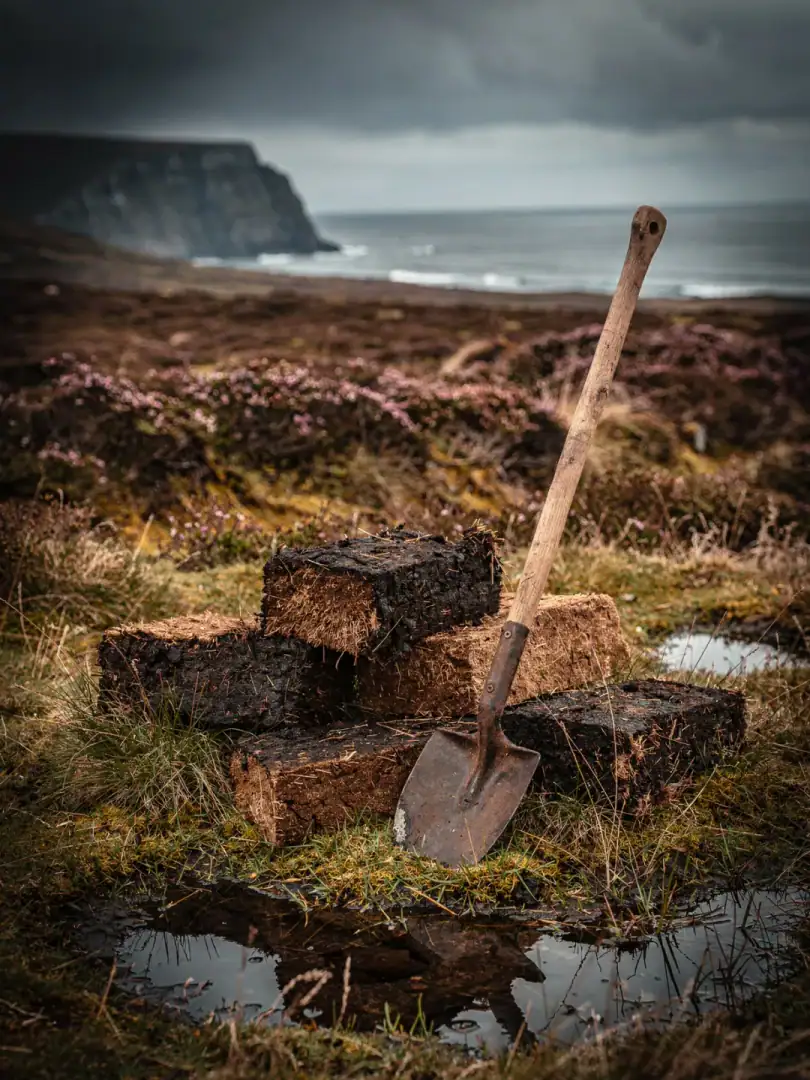
Peat cutters use a wide, flat spade known as a tairsgeir to cut rectangular blocks out of the bog, usually in several layers stacked on top of each other. The uppermost layers are younger and looser, the lower ones older and denser, almost black. Both layers often end up mixed together in the kiln, because they burn differently.
The freshly cut blocks are stacked to dry, often for weeks in the open air, before they're transportable and ready to burn. Today machines take over part of this work, though on Islay peat is still cut by hand as well, especially for smaller maltings.
Islay: Bogs Right on the Coast
The bogs on Islay often lie only a few kilometers from the sea. Salty spray, seaweed and algae drift into the growing peat layer over centuries and settle there. When this peat is burned, its smoke carries a maritime note alongside the pure plant character, one that later resurfaces in the whisky.
Islay whiskies are therefore known for being especially salty and iodine-like in their smoke, as with Laphroaig or Lagavulin, because this coastal proximity shapes the peat accordingly. Other islands in similarly exposed locations, such as Islay's neighbors, share this effect in a milder form.
Orkney and the Mainland: a Different Note
The bogs of the Orkney Islands are also coastal, but consist of a different plant mix with more heather and less seaweed. The resulting smoke often comes across as earthier and less salty than that of Islay, with a sweeter, herb-like edge.
Peat from the Scottish mainland, say from around Speyside or the Highlands, usually lies further inland. Without any sea influence, forest-floor and heather aromas dominate, and the smoke turns out milder and earthier overall. Distilleries often blend peat from several regions to hit a specific character deliberately.
Buying Peat or Cutting Your Own
Not every distillery owns its own bog. Many buy their peat through specialized maltings that smoke for several distilleries at once and adjust the smoke level to order. Only a handful of distilleries, such as Laphroaig or Bowmore, still cut part of their own supply themselves.
Anyone cutting their own peat is usually tied to a specific bog near the distillery and carries its character forward directly. Those who buy in, on the other hand, can choose between peat from different regions and put together their own style more flexibly, depending on which smoky note is wanted at the time.
Protected Bogs, Limited Quantities
Not every bog can be cut into as freely as one likes. Many Scottish bogs today are protected areas, for instance as a Site of Special Scientific Interest, because they're home to rare plant and bird species. Distilleries and maltings often need a permit for peat extraction that precisely specifies how much area and what depth may be cut per year, so the bog can recover between interventions.
This regulation also limits the available amount of traditionally hand-cut peat, which is why many distilleries have switched to machine-cut peat from approved, monitored areas. Small distilleries that still cut by hand often do so in close coordination with local authorities and landowners, rather than freely at their own discretion as was once possible a century ago.
Price and Availability
Peated whisky often costs more than milder bottlings. The reason is rarely the peat itself, which is comparatively cheap. What drives the price up is the longer production planning: maltings need lead time to reliably deliver specific smoke levels. Small batches of rare peat push the price up further still.
Weather and the harvest year also affect how much peat is even available. Wet summers make it harder to dry the cut blocks. If a season fails, the effect only shows up on shelves years later, since malt and whisky both need time to mature. Anyone waiting on a particular bottling is best off planning a year ahead.