Bog and Time
What Peat Is
Half-decomposed plant material from a bog is what we call peat: moss, heather and roots that take millennia underwater to compress. Dried and burned, it produces the smoke that gives some whiskies their distinctive character.
What's Packed Into a Piece of Peat
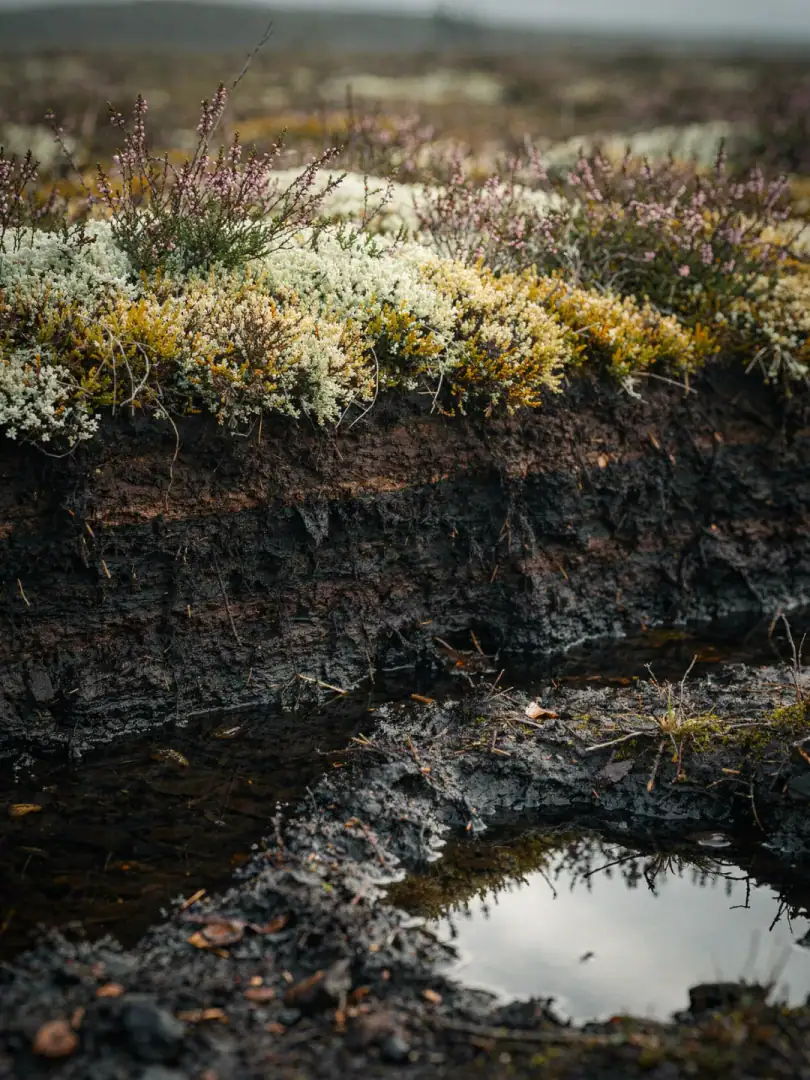
Water barely drains in a bog, and that's exactly what determines what happens to the plants there. They grow, die, and sink into the water instead of rotting away. Oxygen is scarce at the bottom, so moss, heather, grasses and roots break down only very slowly. What remains is a dense, dark mass of half-preserved plant remains: peat.
Sphagnum, a moss with enormous water-holding capacity, grows more abundantly in Scottish bogs than any other plant, and in doing so releases slightly acidic water. This acidic, oxygen-poor environment slows down the bacteria and fungi that would otherwise break down plant matter quickly elsewhere. So layer accumulates upon layer, year after year, over an extremely long time.
How Long a Bog Needs for This
A bog grows on average only about one millimeter in height per year. A peat cutting two meters deep therefore represents a good two millennia of growth, dateable layer by layer like tree rings. What a distiller pulls from the ground today began forming long before the first distillery ever appeared on the island.
On the path toward coal, peat marks only an early stage, nowhere near the end product of that process. Given enough pressure over millions of years, peat would eventually turn into lignite. Whisky producers cut it long before that point, while the plant structure is still recognizable and the material burns well once dried.
Why Peat Smokes at All
Fresh peat is largely made up of water and must dry out before it can burn at all. Once dried, it's dense enough to smolder for a long time with little open flame, much like an incense stick. It's precisely this slow smoldering, not a roaring fire, that produces the dense, oily smoke the malting kiln needs.
The plant remains in peat, particularly the woody parts of heather and grasses, contain compounds that turn into phenols when burned. These give the smoke its characteristic smell of earth, soot and salt, long before it ever meets any barley. How intense this turns out to be depends heavily on the plant mix found in a particular bog.
Peat as an Old Fuel Source
People used peat as fuel long before the first whisky distillery existed. In areas without much woodland, such as large parts of Scotland and Ireland, dried peat was for centuries the most important means of heating and cooking. Entire villages would cut their year's supply in summer and stack it to dry in front of their houses.
The fact that distilleries used peat to dry their malt was therefore, at first, not a deliberate flavor choice but simply the use of whatever affordable fuel was locally available. Only later did distillers recognize how much this smoke shaped the character of their whisky, turning a necessity into a style of its own.
What Else Bogs Preserve
The same lack of oxygen that turns plant remains into peat also preserves other organic material in bogs remarkably well. Archaeologists have repeatedly found well-preserved pieces of wood, leather remains, tools, and even human remains in Northern European bogs that have survived for centuries or millennia because bacteria could barely function in the acidic, oxygen-free water. Some of these bog finds are so well preserved that skin, hair and clothing can still be made out, despite having lain in the ground for several thousand years. This extraordinary preservation shows just how effective a bog's acidic, oxygen-poor environment is against decay, and this exact same principle is what keeps the plant remains in peat intact for millennia instead of turning into soil.
For peat cutters, this means in practice that opening a bog is literally digging into a time capsule, whose deepest layers are far older than any written record of the area. Researchers also use the clearly visible layers in peat to reconstruct past climate conditions, for instance through pollen grains that reveal specific plant species and, with them, specific weather periods. For whisky production this scientific side is usually secondary, but it explains why peat is far more than just a practical fuel for the kiln.