Limestone & Heat
Water & Climate
Jack Daniel didn't pick his spot by chance. Cave Spring Hollow, a karst spring right behind today's distillery in Lynchburg, supplies cool water year-round. It seeps through thick layers of limestone, losing its iron along the way. Iron-free water was crucial for Daniel, since iron gives a distillate a metallic taste and interferes with fermentation.
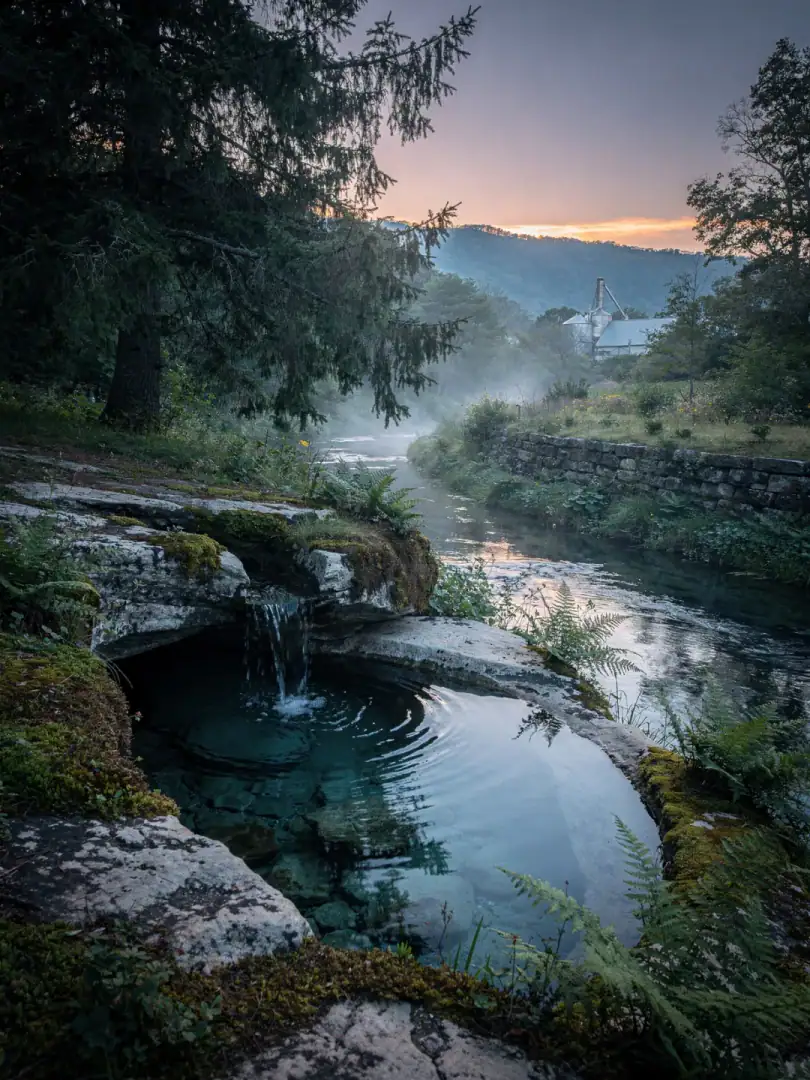
George Dickel's distillery in Cascade Hollow also takes its name from a spring. A small waterfall flows there over the same limestone that underlies all of Middle Tennessee. This rock was laid down millions of years ago as an ancient seabed. It filters out minerals while leaving behind calcium, which helps yeast during fermentation.
Above this limestone lies a climate with little in common with Scotland's damp chill. Summers are hot and humid, often above 30°C (86°F), while winters are cold but rarely freezing. These wide swings between day and night, summer and winter, drive the whiskey deep into the wood and back out again, cycle after cycle, year after year.
Summer heat collects on the upper floors of the warehouses, so whiskey there matures faster than in cooler regions. Barrels stored up top lose noticeably more content to the air, the so-called angel's share. Barrels in the lower, cooler areas, by contrast, mature more slowly and evenly.
Cave Spring Hollow and the waterfall at Cascade Hollow sit less than fifty kilometers apart. Yet both distilleries insist on using their own spring water instead of municipal tap water. Without free access to soft, limestone-filtered water, neither distillery would stand where it does today. That's exactly why you'll hear the same line in both Lynchburg and Tullahoma about how the site was chosen: first came the spring, then came the distillery.