Zakuski & Salad
Vodka & Food
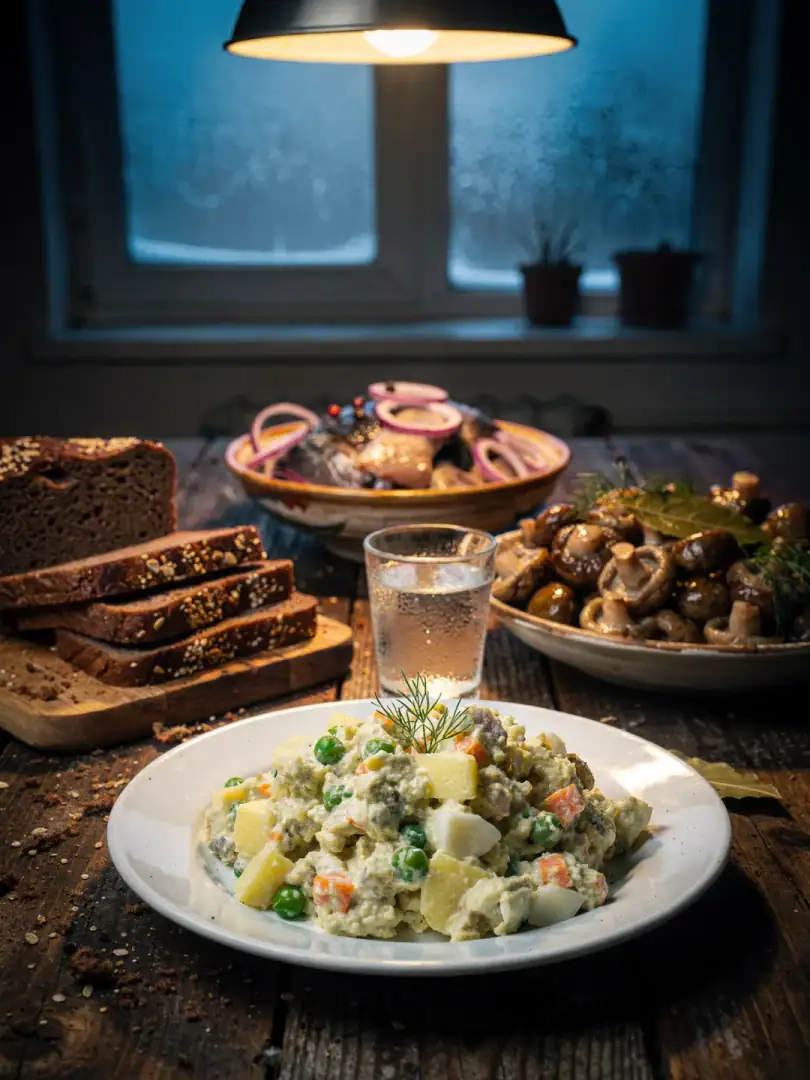
No Moscow drinking night begins without zakuski, the cold snacks that sit on the table before and between rounds of vodka. Dark rye bread, thickly spread with butter and lightly salted, is almost always part of it. So are pickled cucumbers and marinated wild mushrooms from the surrounding countryside.
One classic of the Moscow festive table even traces back to a specific restaurant. Olivier Salad was invented in the 1860s by the Belgian-French chef Lucien Olivier at the Hermitage restaurant in Moscow. The original version included grouse, crayfish tails, and capers. The everyday version today, with potatoes, egg, sausage, and peas under mayonnaise, is still considered a must-have dish for New Year's Eve in Russia. In Russian families, the recipe is still often varied freely, usually with whatever happens to be on hand.
Part of the zakuski logic is that fatty, salty foods are meant to cushion the high-proof vodka. Pickled herring with onions, a spoonful of black caviar on white bread at festive occasions, or a piece of smoked fish all serve exactly this purpose. Each is brought to the table before the next round.
At the table, the fixed order matters more than any single ingredient. First a bite, then the toast, then the glass, never the other way around. Anyone drinking vodka without something alongside it is quickly seen as inexperienced at a Moscow table, no matter how fine the bottle. In Moscow, this order is considered so self-evident that it rarely needs to be spelled out.
With rye-forward Moskovskaya or Stolichnaya, hearty, earthy zakuski like pickled mushrooms and dark rye bread pair especially well, since both sides share the same grain note. A gently filtered Smirnov, on the other hand, gets along just as well with lighter snacks like cucumbers or mild fresh cheese, without being overwhelmed by their aroma.