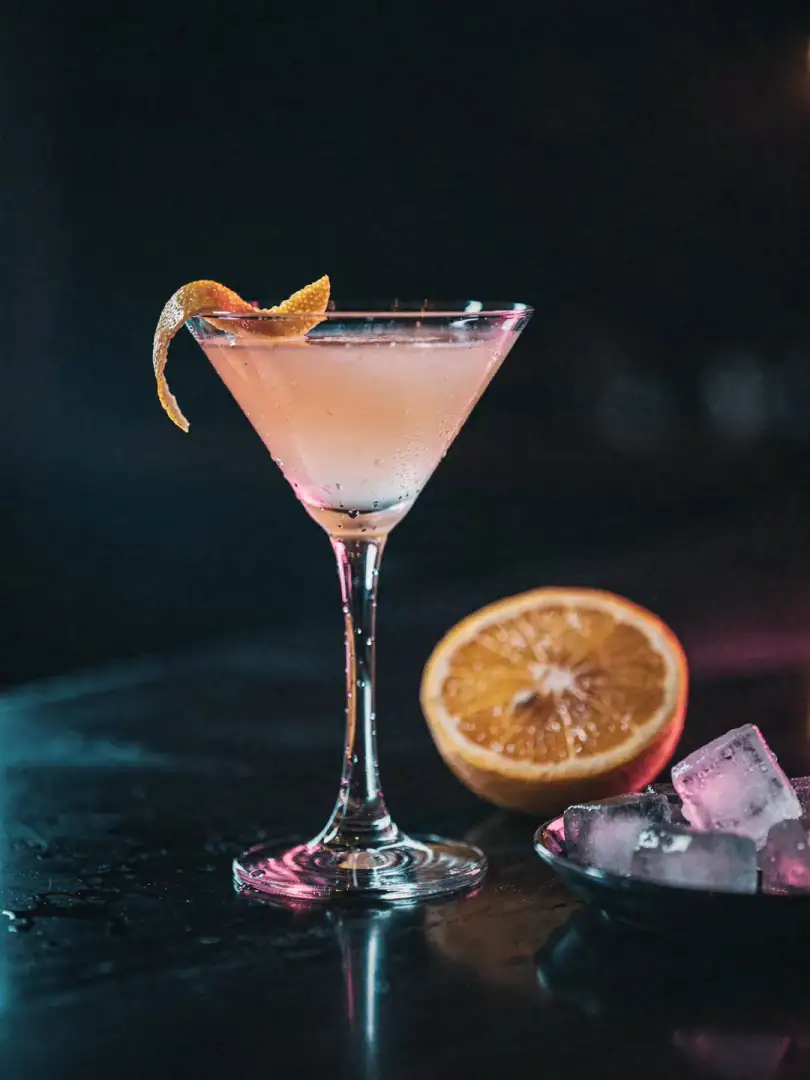
Pink and stylish
Cosmopolitan
The Cosmopolitan made vodka socially acceptable in the 1990s for an audience that had previously tended to reach for wine or Champagne. Pink, elegant, and served in a martini glass, it became a symbol of an entire cocktail culture. This station tells its story and shows the recipe in cl.
Where the Cosmopolitan comes from
As with many famous cocktails, several bartenders claim credit for inventing the Cosmopolitan. In the 1970s and 1980s, similar mixes of vodka, orange liqueur, cranberry juice, and lime appeared independently across the USA. Among those credited are Cheryl Cook in Miami and Neal Murray in Minneapolis.
The Cosmopolitan owes its modern form primarily to Toby Cecchini, a bartender at the Odeon restaurant in New York. In the early 1990s, he refined the drink by using lemon vodka instead of plain vodka and freshly squeezed lime juice. This version spread quickly through New York's bars and became the basis for every Cosmopolitan that followed.
How 'Sex and the City' made the drink famous
The Cosmopolitan became truly world-famous thanks to the US series 'Sex and the City', which aired starting in 1998. The main characters drank the cocktail in practically every bar scene, often served in elegant cocktail glasses garnished with a twist of orange peel. For many viewers, the Cosmopolitan became the epitome of confident, urban cocktail culture.
The show's success sparked a genuine boom worldwide. Bars from New York to Berlin added the drink to their menus, often citing the series directly. This cultural wave played a major role in vodka cocktails coming to be seen as modern rather than simply classic American fare.
The classic recipe in cl
A Cosmopolitan calls for 4 cl vodka, ideally with a hint of lemon, along with 1.5 cl orange liqueur such as Cointreau, 1.5 cl cranberry juice, and 1 cl freshly squeezed lime juice. All the ingredients go into the shaker together and are shaken vigorously with ice. The mixture is then strained into a chilled martini glass, with no ice in the glass itself.
The classic garnish is a strip of orange peel, gently twisted over the glass so its essential oils spread across the surface. Some bars briefly flame the orange peel to intensify the aroma. The drink's characteristic pink color comes solely from the cranberry juice, with no artificial coloring involved.
Why lemon vodka makes the difference
A flavored lemon vodka naturally brings a delicate citrus note that blends with the lime juice and orange liqueur into a harmonious whole. With a completely neutral vodka, the Cosmopolitan tastes a bit flatter, since the citrus element then has to come entirely from the juice and liqueur alone.
This is one of the few classics on this journey where a flavored vodka, rather than a purely neutral one, is explicitly part of the original recipe. If you don't have lemon vodka on hand, you can compensate with a bit more fresh lime, though this only gets you close to the original, not quite there.
Metropolitan and cousins of the Cosmopolitan
Before the Cosmopolitan, there was already the Metropolitan, a similar drink made from brandy, vermouth, and cranberry juice, considered an early relative. Only the switch from brandy to vodka, along with the addition of lime and orange liqueur, led to the recipe known today as the Cosmopolitan.
Modern bars like to vary the Cosmopolitan with other fruit juices, such as pomegranate instead of cranberry, or with different orange liqueurs. The basic structure of spirit, liqueur, fruit juice, and acidity always stays the same, with only the flavors shifting slightly toward sweeter or more tart.
In every variation, ice-cold serving in a pre-chilled glass remains essential, since the Cosmopolitan quickly loses its chill without ice in the glass itself. Placing the glass in the freezer beforehand or swirling it with ice cubes keeps the drink at the right temperature for longer without diluting it through melting ice. Shaking time also matters: shaking too briefly leaves the drink lukewarm and under-diluted, while shaking too long makes it watery and noticeably weakens the aroma of lime and orange liqueur.