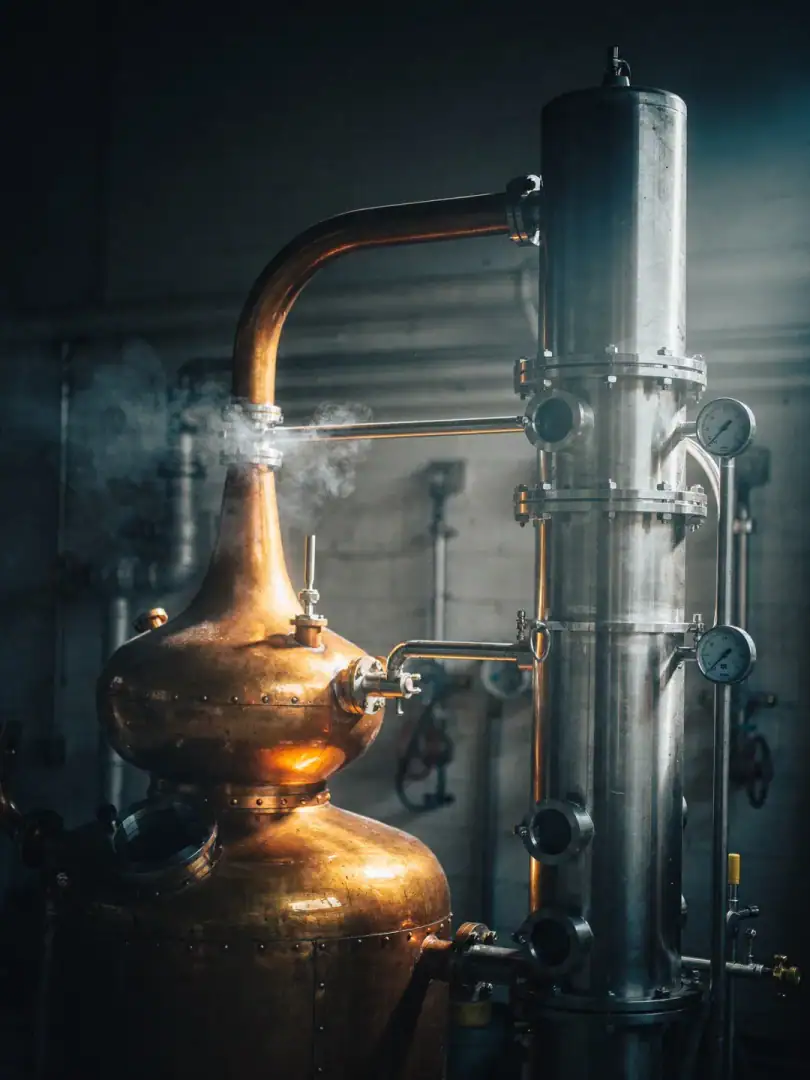
Copper kettle versus column
Pot still or column?
Vodka can be distilled in two very different ways: in the traditional copper kettle, the pot still, or in a tall, continuously operating column. Both methods produce alcohol, but they differ greatly in purity, effort, and speed.
How a pot still works
At its core, a pot still is a large copper kettle with an attached condensing coil. The wash is heated inside it, the resulting alcohol vapor rises, condenses in the coil, and is collected as distillate. After one pass, the alcohol content is usually only 20 to 40 percent. This first distillate is called low wine and is still far from drinking strength.
To achieve higher purity, this first distillate often has to be distilled a second or third time. Each pass costs time, energy, and some volume, but in return gives control over the heads, hearts, and tails of the run, that is, which fraction of the vapor is used. Experienced distillers often decide by smell and taste exactly when to make the cut.
How a column still works
A column consists of several plates or trays stacked on top of one another, through which vapor and liquid flow in a countercurrent. At each plate, the alcohol in the rising vapor becomes further concentrated, while heavier accompanying substances tend to stay lower down. The process runs continuously, not in individual batches. This is exactly where the biggest technical difference from the classic pot still lies.
Because the mash is continuously fed in and distillate continuously drawn off, a column operates around the clock and with high throughput. At the top, alcohol with 90 to 96 percent alcohol by volume can be drawn off, significantly purer than from a simple pot still run. For large production volumes, this is a decisive economic advantage.
Differences in purity and character
The copper kettle, deliberately or not, leaves more aroma in the distillate because fewer separation stages are involved. For whisky or Cognac this is desirable, but for vodka it's more of a disturbance that distillers offset through multiple distillations or filtering. Copper itself also binds unwanted sulfur compounds from fermentation. It's exactly this effect that has kept copper the preferred material for stills to this day.
The column naturally delivers a more neutral, less flavorful alcohol, because the many plates act almost like many successive distillations. For most industrially produced vodkas, this is the preferred route, since it requires less rework and allows consistent quality at large volumes. Flavor nuances here tend to come from the water rather than from the distillate itself.
Who uses which method
Smaller, craft-oriented distilleries more often use pot stills, often out of tradition, sometimes deliberately to retain a minimal inherent flavor that's later marketed as a brand characteristic. The higher effort per liter is usually reflected in the price. Such vodkas are often positioned in the premium segment.
Large vodka brands and alcohol producers, who also supply raw alcohol for other spirits, rely almost exclusively on column stills. They're more economical, run continuously, and deliver the high purity that international standards for neutral alcohol require. For the mass market, this method is practically the only viable option.
Hybrid approaches in modern practice
Many distilleries today combine both principles: part of the distillation runs through a column, with a smaller, flavor-building step additionally passing through a copper kettle. This allows high purity to be combined with a subtle, intentional flavor note, without giving up the efficiency of the column.
Which combination a producer chooses is rarely revealed in detail on the label. Anyone wanting to know how a particular vodka tastes can hardly avoid tasting it themselves, technical specifications alone say little about that.