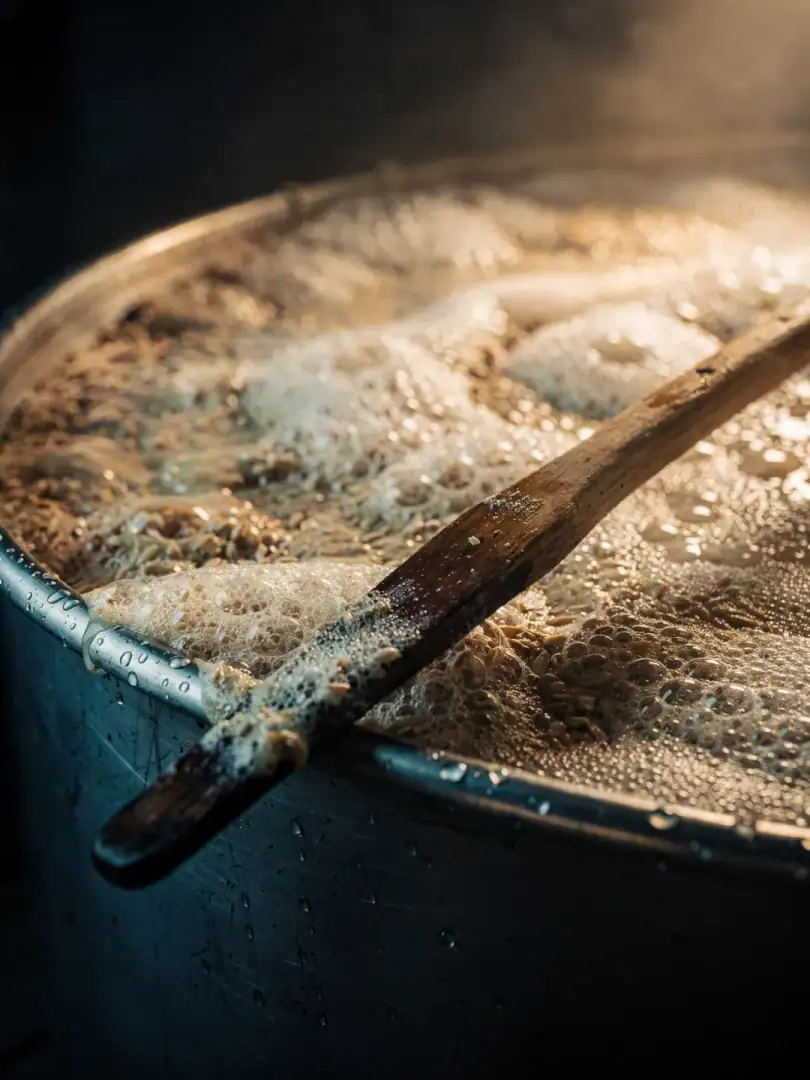
Sugar becomes alcohol
Mash and fermentation
Before any distillation can happen, starchy grain or potatoes must first become fermentable sugar. Enzymes, yeast, and several days of fermentation turn the mash into a mild wash with seven to ten percent alcohol, the foundation of every vodka.
Why starch must first be broken down
Grain kernels and potatoes consist largely of starch, long chains of sugar molecules. Yeast can't do anything with this chain form, it needs individual, small sugar molecules. That's why the starch must be broken down into its components before fermentation, a step familiar to brewers and distillers alike. Without it, most of the raw material would remain out of reach for the yeast.
To do this, the raw material is first milled or crushed and mixed with hot water. The heat breaks open the starch granules and makes them accessible to enzymes. Without this breakdown, the later conversion to sugar would take days instead of hours and remain far less complete. Distilleries therefore control temperature and grind precisely.
Converting starch to sugar with enzymes
For the actual conversion to sugar, distilleries add enzymes, usually amylases from malt or specially cultivated microorganisms. They cut the long starch chains into short sugar units, mainly maltose and glucose. This happens at a controlled temperature, often between 60 and 70 degrees Celsius. Water that's too hot or too cold would weaken or destroy the enzymes.
After one to two hours, the mash tastes noticeably sweeter than at the start. The sugar content can be measured and later determines how much alcohol the fermentation can yield. The more complete the conversion, the more efficiently the distillery uses its raw material. Some producers repeat the measurement several times to hit the right moment for adding the yeast.
Yeast and the actual fermentation
Once the mash has cooled to fermentation temperature, yeast is added, usually special distiller's yeast that can tolerate high alcohol concentrations. The yeast cells absorb the sugar and convert it into alcohol and carbon dioxide, a process known as alcoholic fermentation that provides energy for the yeast. Some distilleries also add nutrient salts to keep the yeast working vigorously.
Fermentation takes between two and four days, depending on the raw material and temperature. It's visible through rising carbon dioxide bubbles and a slightly sour smell. Toward the end of fermentation, sugar becomes scarce and yeast activity noticeably slows. Temperature is often monitored closely so the yeast doesn't die off from excessive heat.
What results at the end of fermentation
What remains at the end is the wash, a cloudy liquid with seven to ten percent alcohol, depending on the recipe and raw material. It tastes similar to a simple, unhopped beer and contains, besides alcohol, yeast residue, fusel oils, and aroma compounds from fermentation. This alcohol content is far from enough for a ready-to-drink product.
This wash isn't vodka yet, but merely the starting material for distillation. Only heating in a pot still or column separates the alcohol from water and accompanying substances, turning the mild fermented liquid into the high-proof distillate that later becomes vodka. The two common distillation methods for this are the focus of the next stop.
Why the choice of raw material affects the effort involved
Potatoes contain less starch per kilogram than grain and therefore must be processed in larger quantities to yield the same amount of alcohol. This historically makes potato vodka more labor-intensive to produce, even though it's considered especially traditional in certain regions like Poland.
Rye and wheat, by contrast, deliver high starch yields and are easier to store and transport, which makes them attractive for large distilleries. Which raw material is chosen ultimately depends on availability, cost, and regional tradition, not on any technical necessity.