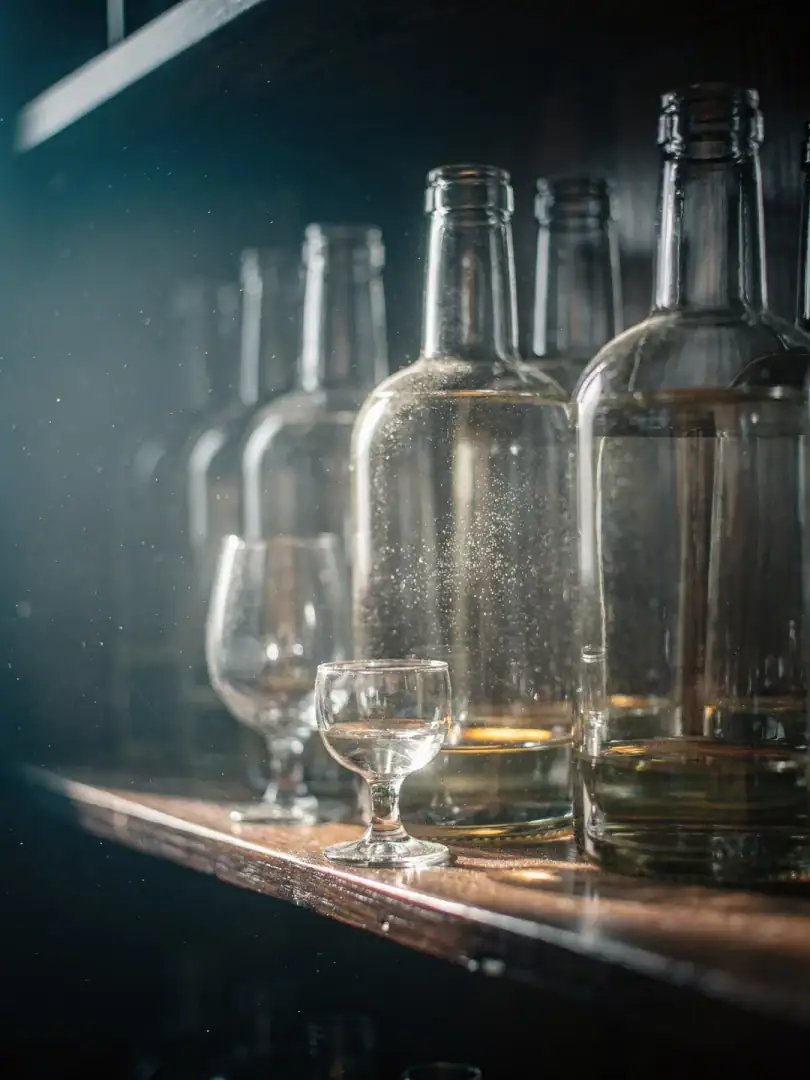
Storage and shelf life
Storing vodka and shelf life
Unlike wine, vodka doesn't improve in the bottle, but it also doesn't spoil in the way many people fear. A few simple rules are enough to keep a bottle tasting exactly the same for years as it did on the day it was bought.
Why vodka practically doesn't spoil
The high alcohol content is the main reason for this stability. The EU Spirit Drinks Regulation requires vodka to have at least 37.5 percent alcohol. In practice, most bottles come in at 40 percent or more. At this alcohol content, bacteria and mold can practically not survive. That's why an unopened bottle stays unchanged for a very long time.
A printed best-before date, mandatory for many foods, is therefore usually not found on vodka at all. Spirits with such a high alcohol content are legally considered non-perishable. They are exempt from this labeling requirement. So there's simply no expiration date in the classic sense.
Properly storing an unopened bottle
Unopened, vodka can be stored at room temperature in a dark place for years without any change in taste. The main thing is to avoid direct sunlight. Over very long periods, UV radiation can slightly alter fine aroma compounds and any coloring agents, even though the alcohol itself remains unaffected.
Unlike wine with a cork, the position of a bottle of vodka with a screw cap makes barely any difference. Drying out of the cork, as can happen with wine, is never an issue here. Storing the bottle upright only slightly reduces contact between the alcohol and the closure. Over a very long time, that slows down evaporation through the seal.
The freezer and opened bottles in everyday life
The freezer does no harm to a bottle of vodka, whether it's open or unopened. Commercial vodka only starts to solidify well below minus 20 degrees Celsius because of its alcohol content. In a normal household freezer, it therefore stays liquid and unchanged, just a bit colder and thicker. That said, permanent storage in the freezer isn't necessary — a cool cupboard is perfectly adequate for most purposes.
Once opened, the contents themselves change very little over the years, as long as the cap is screwed on tightly between uses. A tiny amount of alcohol can evaporate through the closure over a very long period. After many years, this slightly lowers the alcohol content of a half-empty bottle, but it's barely noticeable in terms of taste.
Flavored vodkas, which have had fruit extracts, herbs, or spices added, are a bit more sensitive. Over time, these additions can lose intensity once the bottle is open, much like a jar of spices left uncovered. The alcohol itself, however, remains stable. An opened bottle of flavored vodka is therefore best enjoyed within one to two years of opening. Classic, unflavored vodka stays unchanged for much longer.
A practical rule of thumb for storage
In practice, a simple rule of thumb is enough: store the bottle upright in a dark spot that isn't too warm, and screw the cap on tightly after each use. For flavored varieties, it's also worth using up the bottle within a reasonable time. Special equipment such as a wine fridge or a dedicated storage room simply isn't necessary for vodka.
Why vodka doesn't mature in the bottle
Unlike whisky or certain wines, vodka doesn't continue to mature in the bottle, even if it sits unopened in a cupboard for years. Maturation in the classic sense usually comes from the slow interaction with wood and air in a cask, as with whisky. With wine, similar effects arise from chemical processes taking place over years in the bottle. Vodka, by contrast, is almost always stored in glass with a tight screw cap, with no meaningful contact with oxygen or wood. As a result, the structure of the liquid barely changes over time.
So an older bottle from your grandparents' cellar is neither more valuable nor better than one freshly bought — as long as it was tightly sealed and not exposed to extreme heat or direct sunlight. For collectors, what matters with old bottles is usually the look or the story behind the label, not any change in taste inside.
If you have several opened bottles of the same vodka, you can safely combine them into a clean, empty bottle, as long as you're not mixing flavored varieties. This saves space in the cupboard and doesn't change the actual taste at all, as long as the bottle is then sealed tightly again.