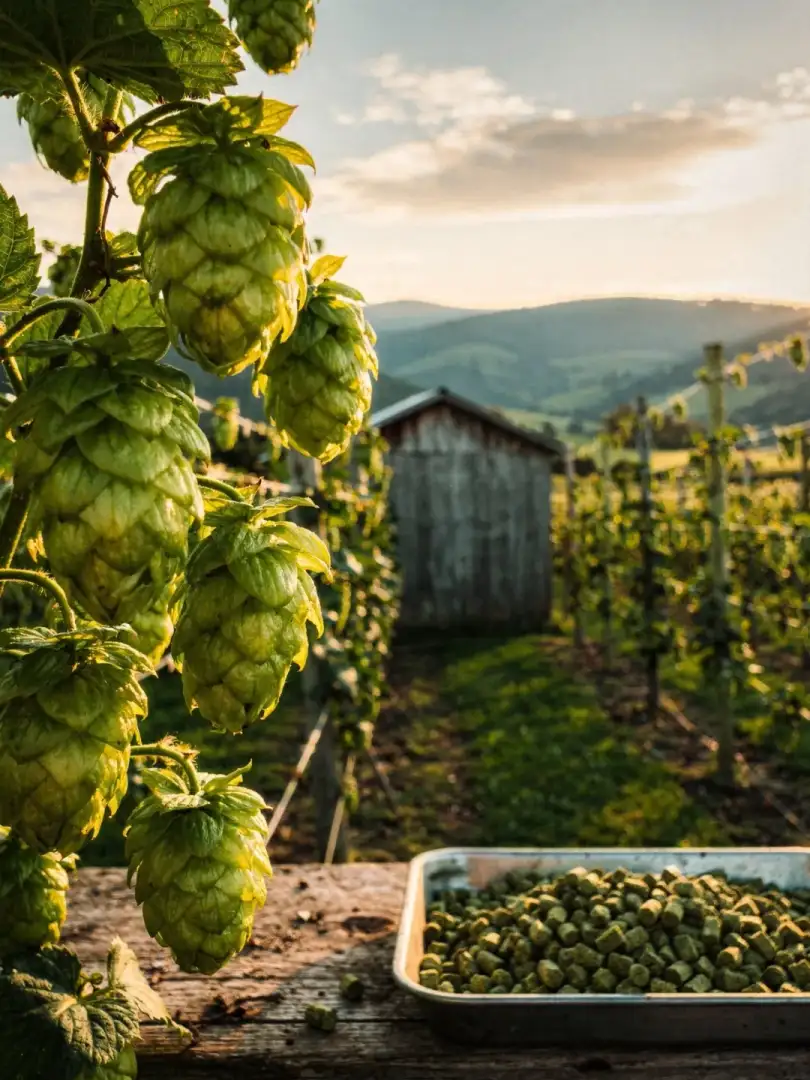
Cascade and Galaxy
Hops
Where do the hops for a Western Australian Pale Ale come from? Not from Perth's surroundings. Australia's hop growing is centred in Tasmania and Victoria, and many brewers supplement it with imports from the US. Two varieties dominate: Galaxy and Vic Secret, both from Australia, and Cascade from North America.
Cascade is an American variety from 1972 and is considered a blueprint for what would later be called "craft hops." It has a fragrance of grapefruit and blossoms. According to the brewery, Little Creatures embraced an American-style Pale Ale from the very start, a style that was unusual in Australia at the time.
Galaxy, by contrast, smells of passionfruit and peach. These tropical notes are what make so many Australian hop-forward beers appealing today. You get them when hops are added late in the process or after fermentation rather than early in the boil — the so-called dry hopping. This way, the hops lend the beer aroma but barely any bitterness, since the heat needed to release bittering compounds is absent.
Bitterness and aroma are two separate things. Boiling hops early extracts bitterness, measured in IBU, a unit for bittering compounds: the higher the number, the more bitter. Adding hops late extracts aroma. Feral Hop Hog shows the signature of the region: a beer that smells more of hops than it tastes bitter. How strong the bitterness ultimately turns out depends on the brewery's recipe, because hops alone don't make a beer — they need a malt backbone to carry them and a yeast that lets them shine. Too much bitterness without malt tastes harsh, too little leaves the beer tasting flat.