Sand, Clay, Heath
Water & Soil
Where does the Antwerp province's brewing water come from? Mostly from groundwater, and that groundwater sits beneath very different soils. To the east, the Kempen stretches out with its sandy ground, while to the west and along the Scheldt, clay and alluvial land dominate.
Sand lets rain seep away quickly, filtering it as it goes. Water from the Kempen is therefore considered relatively soft, while water from the soils along the Scheldt is seen as more mineral-rich. Just how hard the water really is at any given well is something each brewery determines for itself.
For the beers of this region, this matters less than it does for a Pils. Tripel, Dubbel and Golden Strong rely on yeast, malt and fermentation management, and as is the case almost everywhere, brewers treat their water before brewing begins. Water alone no longer defines the style today. The fact that a Tripel from Westmalle and a Duvel from Breendonk taste so different comes down to recipe and yeast, not the well.
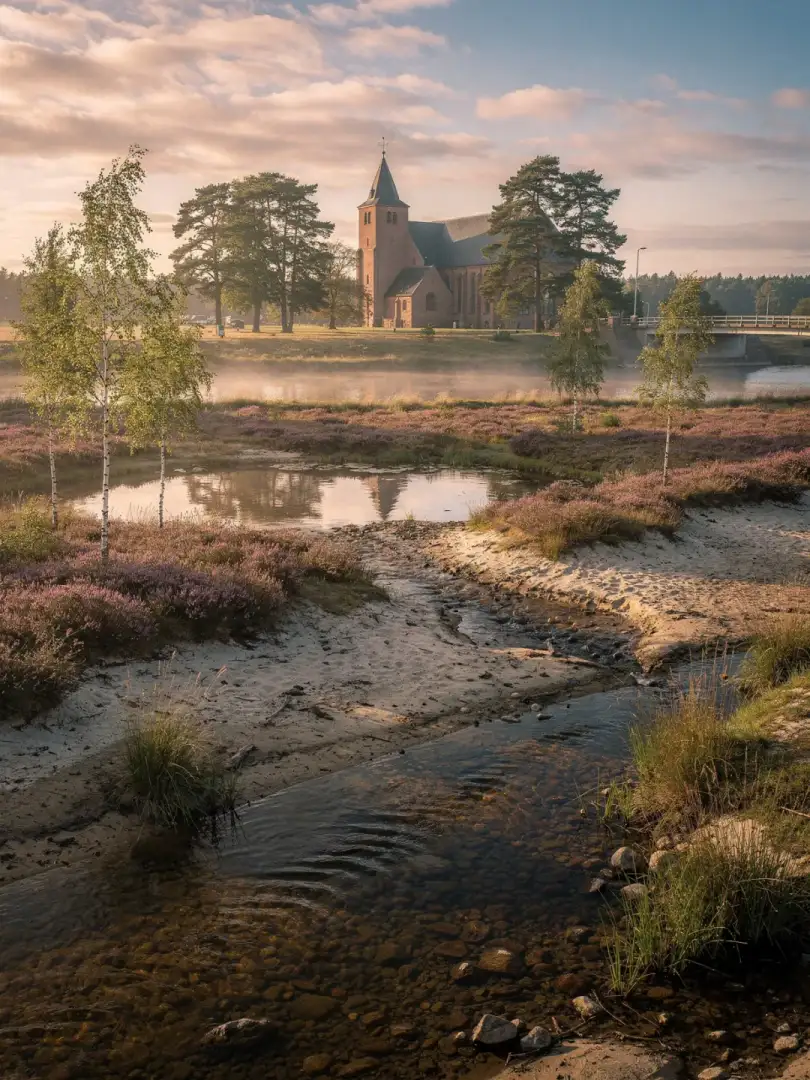
The Kempen is flat heathland, forest and moor, crossed by canals and spruce plantations. Away from the cities, that's where the monasteries stand. Achelse Kluis sits right on the border with the Netherlands, while Westmalle lies in the province of Antwerp, surrounded by fields and woodland.
There are no rock-cut cellars here like you'd find in Franconia. Beer is aged in tanks and brick-lined cellars, and because the climate near the North Sea is mild and damp, cellar coolness matters less than carefully controlled temperatures in the fermentation and conditioning rooms.