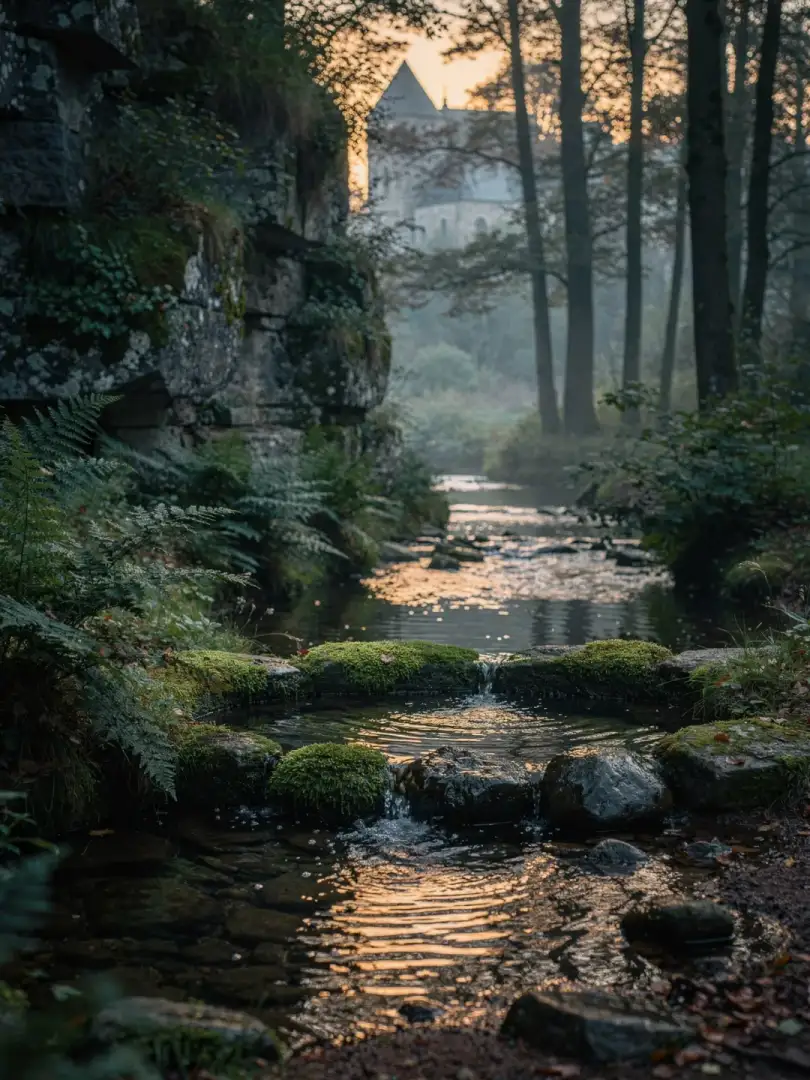
Mathilde's Spring, Forest
Water & Soil
Orval's brewing water comes from the abbey's own Mathilde's Spring on the monastery grounds. The brewery heats it to 65°C (149°F) and adds it in during the malt milling itself. A Trappist beer from the Gaume thus has an unusually short path from spring water to the mash, the mixture of crushed malt and warm water.
The landscape around Orval is forest and hill country. The Gaume consists of Jurassic-era rock, which tapers off southward toward France as part of the Lorraine cuesta formations. Where such layers collect rainwater and release it slowly, springs with steady water form — exactly what a brewery needs.
How does brewing water affect beer? Dissolved minerals are the key factor. High carbonate content makes water hard and dampens the mash's acidity, which favors dark beers. High sulfate content, on the other hand, accentuates hop bitterness and makes a beer taste drier. Orval is a hoppy, very dry beer, with a light acidity on the finish according to the brewery.
Mathilde's Spring is thus more than just an ingredient. It has belonged to the brewery since it began operations in 1931, and it links the legend of the lost ring to the beer of today. Whoever drinks an Orval is tasting the water of the valley that gave the abbey its name.
Climate also plays a role in maturation. After bottling, Orval is left to referment for roughly three to five weeks at about 15°C (59°F) in climate-controlled rooms. That's considerably warmer than a lager beer, which rests cold for weeks. The warmth is intentional, since the yeast in the bottle works quickly and thoroughly at this temperature.