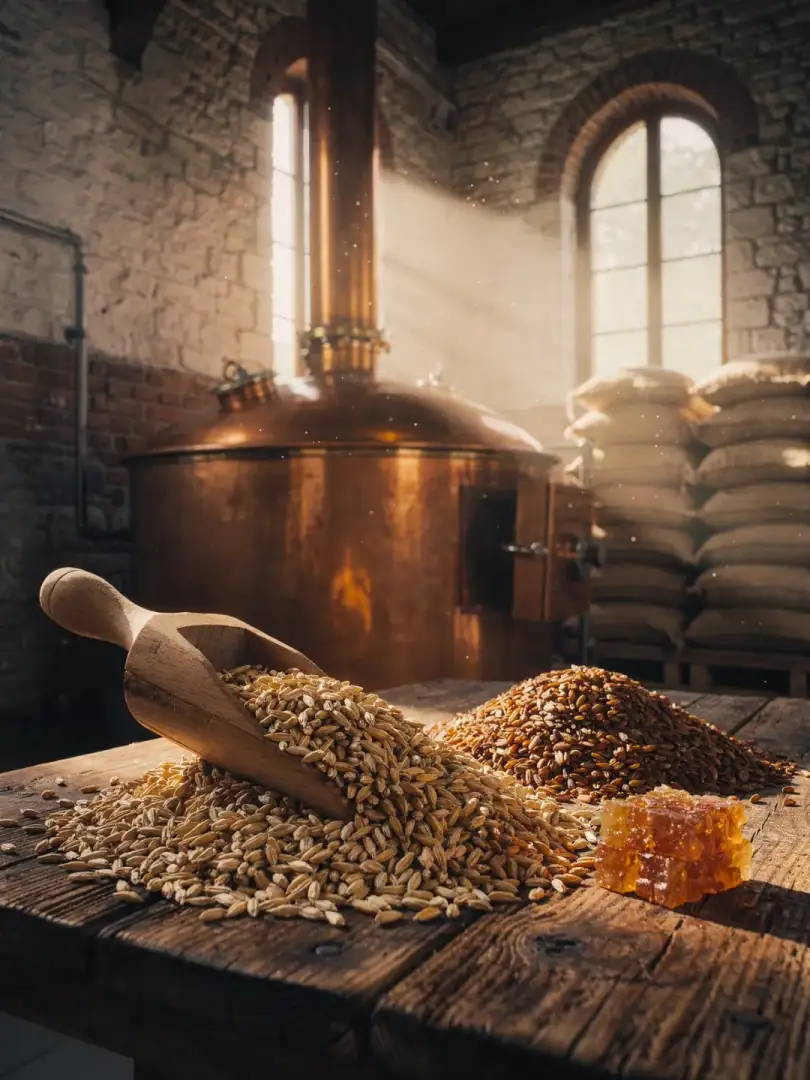
Pale Malt, Candi Sugar
Malt & Grain
Orval gets by with remarkably little malt. For the brew, the brewery uses a pale malt and a small proportion of caramel malt. Malt is barley that has been germinated and then kilned — gently dried — and the color of the beer depends on how hot it was dried. Pale malt gives Orval its orange-gold color, while the caramel malt adds a subtle sweetness in the background.
The milling process is notable. Orval mills its malt wet: water from Mathilde's Spring is added at 65°C (149°F) right at the grinding stage. This keeps the husks, the outer shells of the barley grains, elastic rather than ground into fine flour. During the subsequent lautering, the separation of the clear wort from the spent grains, this creates a loose natural filter.
Sugar is added as well. Before the first fermentation, the brewery adds liquid candi sugar to the cooled wort. Yeast ferments sugar completely, which makes a beer dry rather than leaving it sweet. That's why Orval feels so lean despite its robust alcohol content, which the brewery states at 6.2 percent.
For comparison with Germany: there, sugar in beer is tightly regulated. Top-fermented beers outside Bavaria may contain certain technically pure sugars, while in Bavaria none at all is allowed. Belgian brewers, by contrast, use candi sugar as a matter-of-fact brewing tool, and it's part of many Trappist beers.
The result of pale malt, caramel malt, and candi sugar is a beer that relies on barley without putting it front and center. The malt aromas stay quiet, letting hops and yeast take the leading role in the glass. That's what makes Orval a beer you recognize more by its dryness than by its malt character.