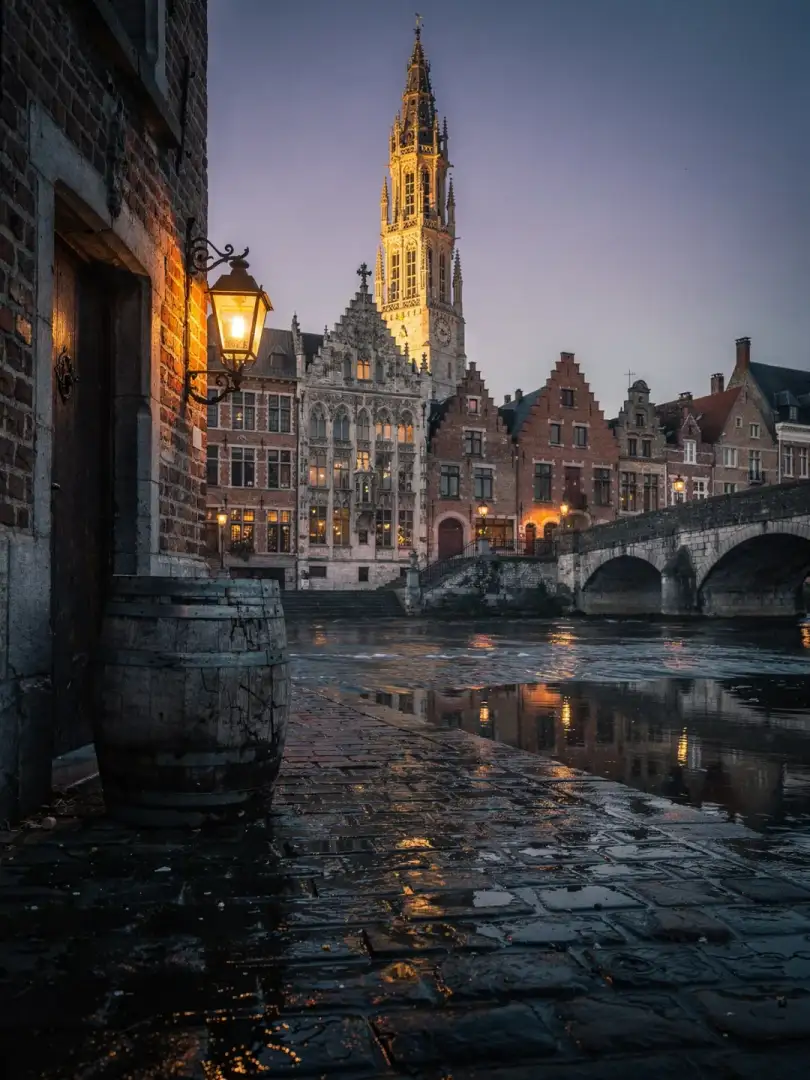
Scheldt, Leie, guilds
Region & History
East Flanders is the province around Ghent, where the Scheldt and Leie rivers meet, and it's one of the most beer-dense landscapes in Belgium. If you ask where Flemish brown beer comes from, the answer leads to Oudenaarde, a small town on the Scheldt where Oud Bruin has been at home for centuries.
The Liefmans brewery in Oudenaarde cites 1679 as its founding year. It has carried its current name since 1780, when heiress Maria Vilet married a certain Jacobus Liefmans. In 1933 the operation moved from the town center to the banks of the Scheldt. Then things got turbulent: in 1991 the Riva Group from Dentergem bought the brewery, Riva went bankrupt in 2007, and production ground to a halt. A year later Duvel Moortgat of Breendonk took over Liefmans, and brewing has continued in Oudenaarde ever since.
In the village of Mater, now part of Oudenaarde, stands the Roman brewery. By its own account, its history began in 1545, when Joos Roman ran the inn De Clocke there. The property included a mill, a malthouse, and a brewery, and the road outside was a trade route between Germany and France. Roman calls itself Belgium's oldest family-owned brewery.
Ghent, the provincial capital, relied on herb blends known as "gruut" long before hops took hold. The city brewery Gruut has revived this tradition since 2009. In Melle near Ghent, Huyghe brews beer at a site first mentioned as early as 1654, where Leon Huyghe founded today's brewery in 1906. Buggenhout, in the western part of the province, is home to Bosteels, founded in 1791.
There's no EU protected designation of origin for East Flanders. The name "Oud Bruin" describes a style, not a protected origin. What sets the province apart is its blend of old brown-beer craftsmanship, herbal tradition, and strong beers with histories of their own.