Deep Springs
Water & Soil
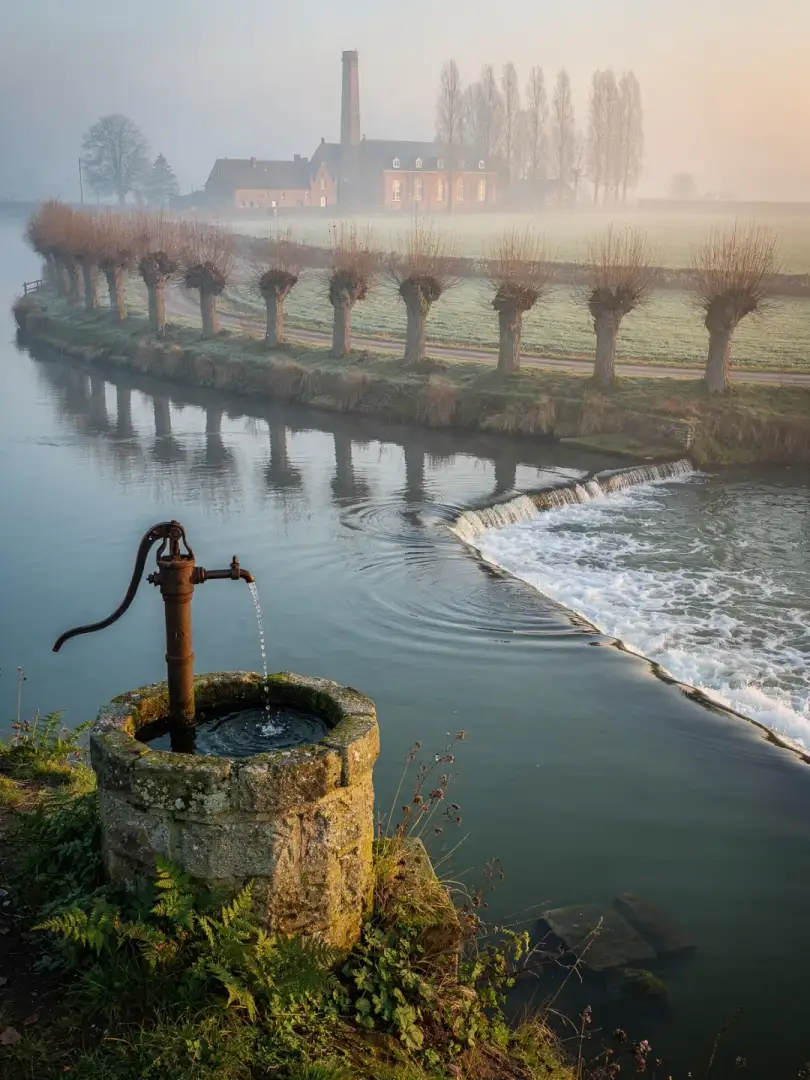
Why does the Oud Bruin from Oudenaarde taste so round and mellow? Part of the answer lies beneath the town. For centuries, Oudenaarde's brewers drew water from numerous small springs lying around a hundred meters deep.
This deep water carries a high level of sodium bicarbonate, a salt that buffers acidity during brewing. Dark malts naturally acidify the mash, and water like this counteracts that tendency. It's considered especially well-suited to brown beers. There's no data series to cite here—this remains a qualitative description.
The land is flat, crisscrossed by the Scheldt and Leie rivers. Where the soil is moist and the climate mild, barley thrives, and proximity to water made transporting barrels and grain easy. It's no coincidence that old beer towns like Ghent and Oudenaarde sit along the rivers.
At the same time, what holds true for nearly all brewers holds true here too: today breweries treat their water with filters, softening, or targeted salt additions. The springwater character is therefore more a matter of heritage than recipe. It explains why brown beer, not pale pilsner, became tradition in Oudenaarde.
Hillside cellars like those found in Franconia or Bavaria are rare here. Oud Bruin aged in barrels and tanks, at cool but not cold temperatures, over long stretches of time. Patience stood in for rock cellars: the beer needed time above all, not cold.