Lembeek & Blender
Region & History
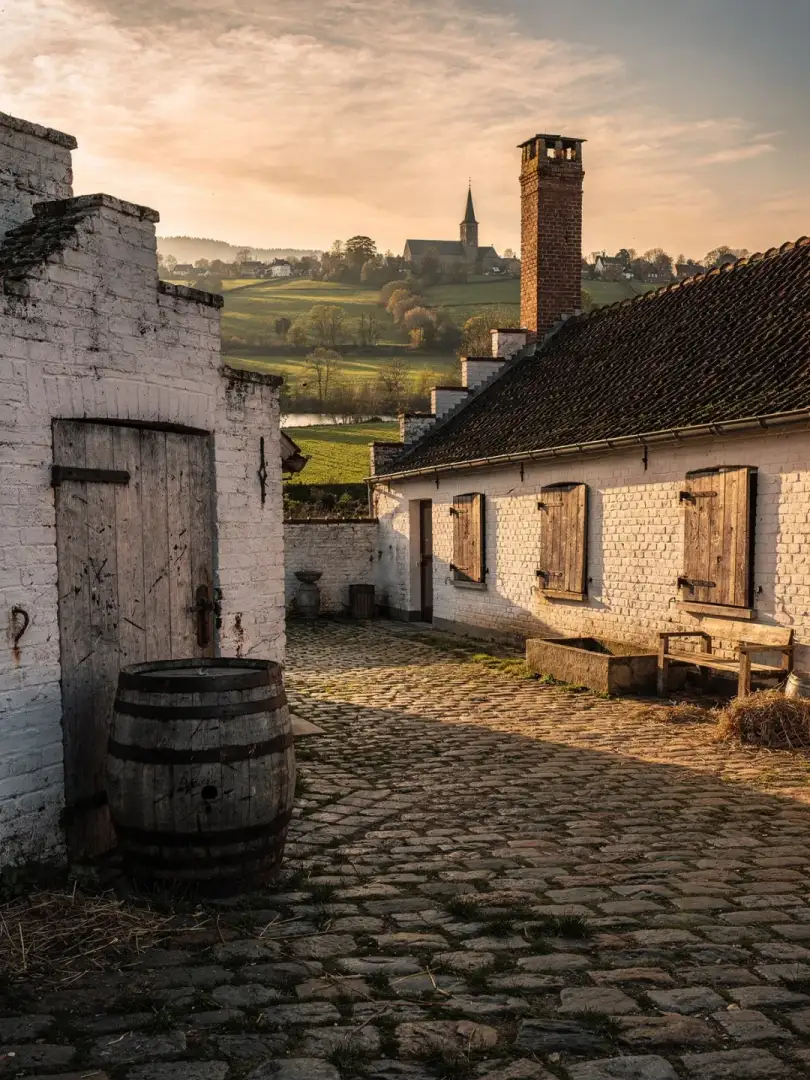
Lambic comes from the Pajottenland and the Senne Valley, the hilly country west and south of Brussels. The name derives from Lembeek, a village on the Senne that today belongs to the town of Halle. The Boon brewery still stands there today.
It's hard to say exactly how many Lambic producers there are, since roles overlap. Some brew themselves, others age and blend Lambic from various sources, like 3 Fonteinen in Beersel. Then there's Lindemans in Vlezenbeek, Timmermans in Itterbeek, Girardin in Sint-Ulriks-Kapelle, and Oud Beersel.
How precarious things once became is shown by Boon. Frank Boon started out in 1975 as an independent Geuze blender in Halle, moved to Hondzocht near Lembeek in 1978, and brewed in the new brewhouse in autumn 1990; according to the brewery, it was the first new Lambic brewhouse built in more than forty years. The brewery traces its roots back to 1680. Today it's half owned by the Boon family, and since 2014 the other half has belonged to Diepensteyn NV, the parent company of Palm.
Is Lambic a protected name? Since 1997, Lambic, Gueuze, Kriek, and Faro were listed in the EU register as Traditional Specialties Guaranteed, without name reservation. That protection expired on January 4, 2023. Still protected, now with name reservation, are "Oude Geuze" and "Oude Kriek," along with variants like "Oude Lambiek"; only producers following the defined process may put these names on the label.
The protection is tied to process, not place. The idea that Lambic should come from the Senne Valley is tradition, part of the convention upheld by HORAL, the association of brewers and blenders from the Pajottenland and Senne Valley. This geographic tie has nothing to do with EU law, and Cantillon in Brussels stands outside the association.