Hills & Cellar Air
Water & Soil
What kind of water does Lambic need? Nothing particularly special, unlike a Pilsner, because here fermentation shapes the beer, not the mineral content of the water. As is true almost everywhere, breweries treat their water today before it goes into the mash. Hardly anyone still speaks of "Lambic water."
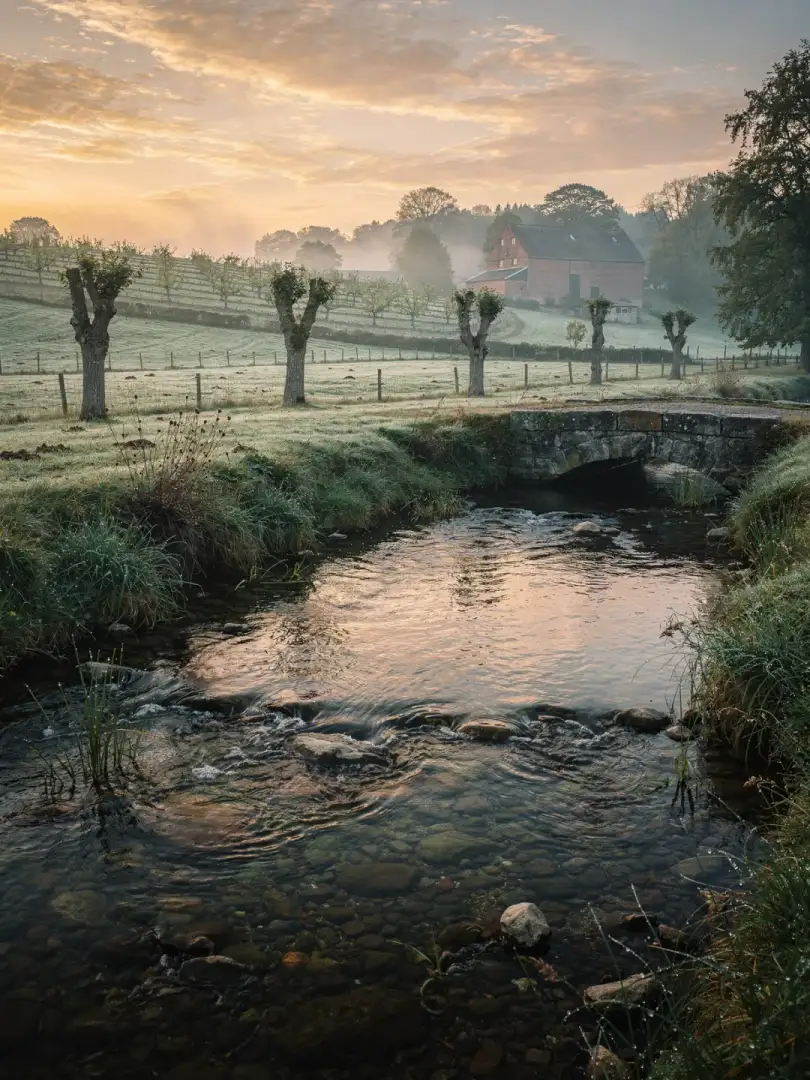
More important is the landscape. The Pajottenland is gentle hill country of meadows, fields, and orchards, crossed by the Senne, which flows through Lembeek and Halle. It lies just a few kilometers from the center of Brussels yet feels thoroughly rural. From Beersel you look out over pastures and hedges, hardly any industry in sight.
Sour cherries and other local fruit traditionally go into young Lambic. That's true both for the fruit beer Kriek and for raspberry Lambic, and the orchard behind the farmhouse belongs to the brewery just as much as the barrel does.
According to popular lore, the microorganisms that ferment Lambic live in the air of the valley and in the wooden beams of the brewhouses. This belief is why many brewers consider the beer genuine only when made here. Experts don't deny that the microbial world could, in principle, be recreated elsewhere.
The climate of aging follows the seasons. The barrels lie in halls, cellars, and attics that grow warmer in summer and cooler in winter. This slow rhythm is deliberate, since fermentation is allowed to stretch over years, whether at Boon in Lembeek or in the cellars of 3 Fonteinen.