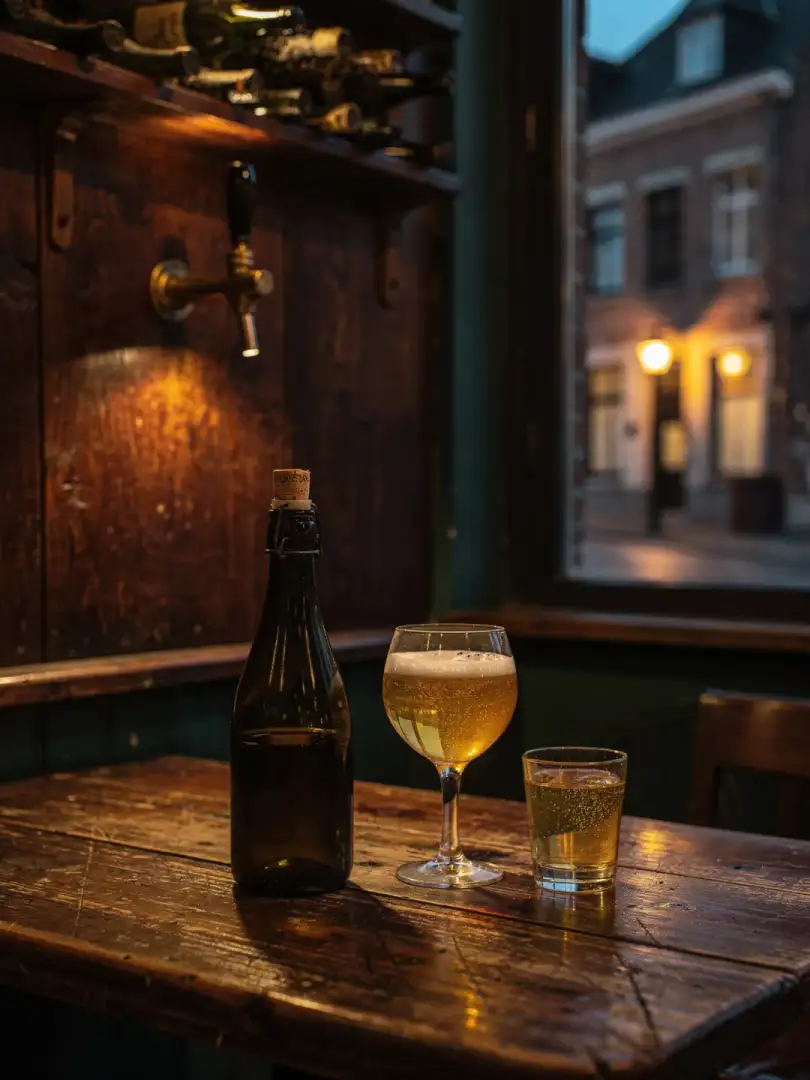
Cork & Tulip Glass
Tasting
What does Gueuze taste like? First comes the acidity, bright and sharp like lemon or green apple, then hay, a hint of barnyard, dry wood, and a long, clean finish. Sweetness is almost entirely absent, as is bitterness. Anyone who has never tried a sour beer before should think of cider or dry sparkling wine.
Good examples include Oude Geuze from Boon and from 3 Fonteinen, both aged in barrel and bottle. Girardin from Sint-Ulriks-Kapelle represents a beer that many find milder. Sweetened fruit beers, like those made by Lindemans and Timmermans, offer a gentler entry point and taste more like cherry juice than cellar air.
Which glass suits it? Gueuze is usually served from a slender tumbler, a tulip glass, or a champagne flute. A bottle with cork and wire cage resembles champagne, and when opening it, you should hold it steady, since the foam can rise quickly.
Serving temperature should be cool but not ice cold, roughly cellar temperature. Beer served too cold mutes fruit and wood, while beer served too warm loses its tension, making the acidity feel broader and less fresh.
When pouring, some yeast sediment usually remains at the bottom of the bottle. Pour slowly in one steady motion and leave the rest behind in the bottle, so the glass stays clear. A Hefeweizen, by contrast, is often poured along with its yeast; with Gueuze, the yeast stays in the bottle. Anyone who drinks the last drops along with the sediment gets a cloudy, yeasty, and usually more bitter sip.