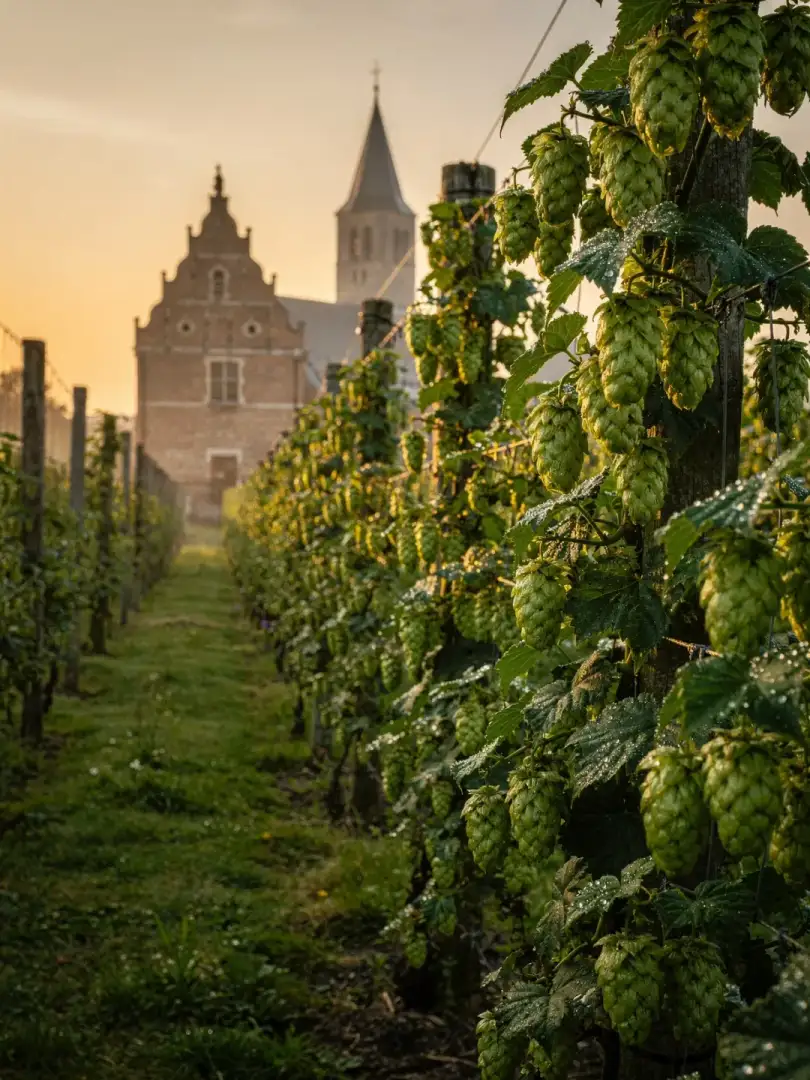
Hop Town Poperinge
Hops
Poperinge calls itself Belgium's hop capital, and the title fits: scaffolding rises around the town where the bines climb several meters skyward each summer. According to the Belgian Hop Growers' Association, 17 hop farmers in the area cultivate around 155 hectares.
That's modest compared to the Hallertau, but substantial for a country where hops otherwise barely grow at all. It used to be more. Until the 1960s, hops were weighed at the Stadsschaal, Poperinge's old town scale and inspection house. There, the hops were weighed and graded before heading to the brewers. Today the same building houses the Hop Museum.
Why does beer need hops at all? The cones provide bitterness to balance the malt's sweetness, plus aromatic oils reminiscent of herbs, flowers, or citrus. Hop early in the boil, and you get mostly bitterness. Hop late, and you preserve the aroma. In strong Belgian beers, hops tend to play a supporting role rather than the lead.
Harvest falls in late summer. The hops are cut, stripped from the bines, and dried. It's celebrated at the Hommelfeesten, a beer and hop festival held every three years on the third weekend of September. According to the town, more than 1,300 volunteers help out.
The plant plays a role beyond the brew kettle too. In spring, the young shoots appear on the table as hopscheuten, a vegetable as familiar in Poperinge as asparagus is elsewhere.