Limestone Beneath Zealand
Water & Soil
Why is the water in Copenhagen so hard? Because the city sits on limestone. Beneath Zealand lie layers of limestone and chalk, and Denmark draws its tap water almost exclusively from groundwater that filters through sand and these mineral layers.
The utility company HOFOR reports a hardness of roughly 17 to 25 degrees on the German hardness scale for Copenhagen. This unit, abbreviated °dH, measures dissolved calcium and magnesium salts. Anything above 14 degrees counts as hard water in Germany, so the Danish capital is well above that threshold.
For pale lagers, such water is a challenge. The carbonates strip some of the acidity from the mash—the mixture of crushed malt and water—leaving the beer tasting slightly harsh and flat. Soft water, like that in Pilsen, suits a pale pilsner better. Carbonate-rich water, as found in Munich, Dublin, and London, tended to produce darker beers instead.
Today, almost every brewery treats its water, whether through softening, reverse osmosis, or salt additions. So water alone no longer defines the style. A pilsner from Carlsberg and a stout from the craft scene can start from the very same tap and still end up worlds apart.
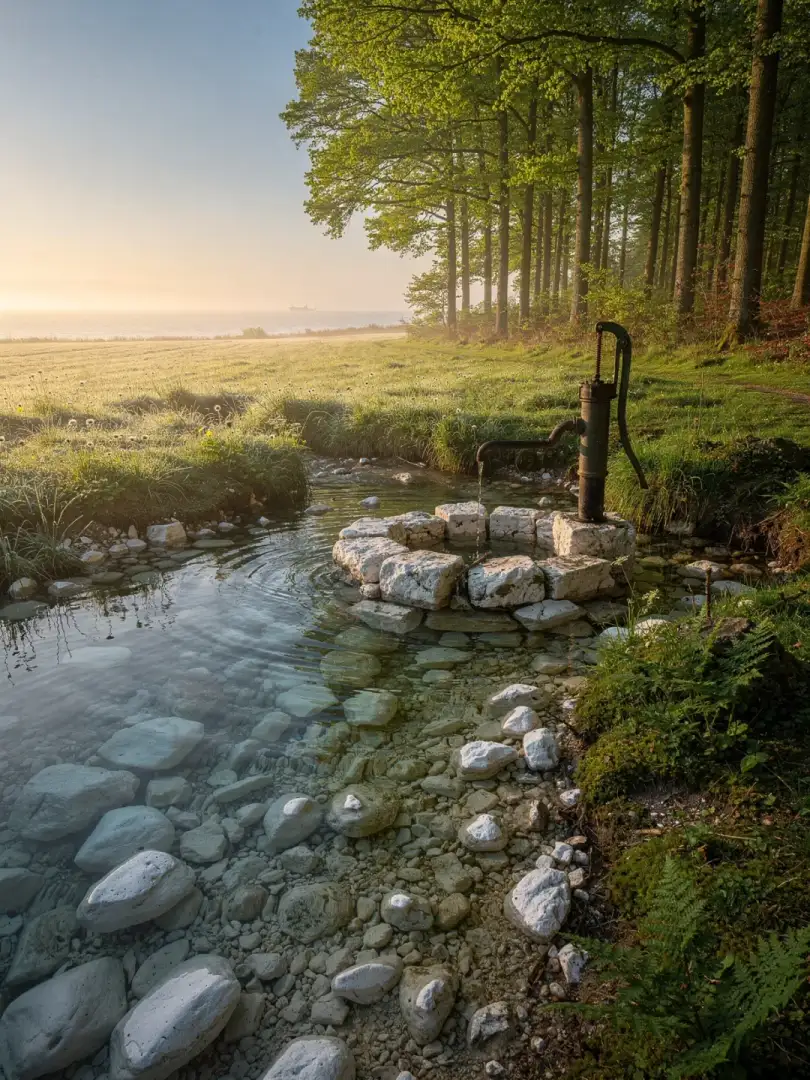
How crucial a good water source can be is shown by Faxe, further south on Zealand. In the 1930s, the brewery there drilled a well and struck limestone-filtered water at a depth of around 80 meters—water that its production still relies on today.
Breweries without their own facilities, like Mikkeller in its early days, brew with whatever water their host site provides. Breweries with a permanent home tailor their water to the style they want to brew. Around the Øresund, groundwater remains the starting point either way.