Cold and Long
Yeast & Fermentation
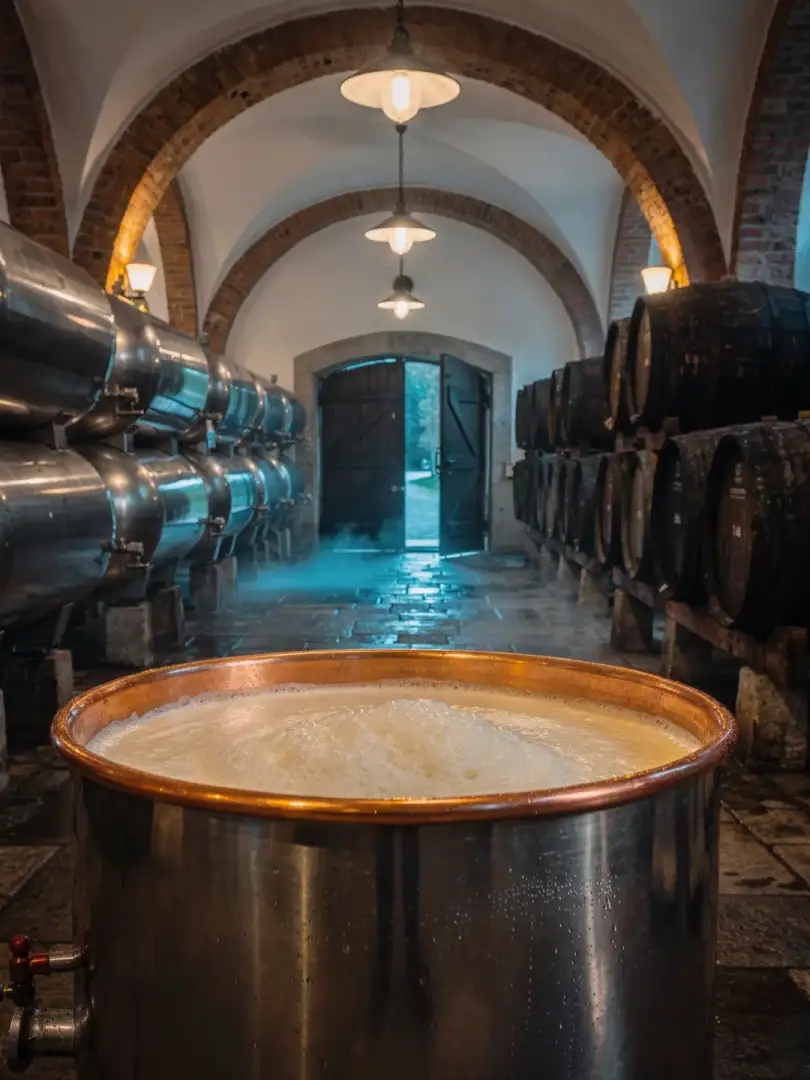
Two kinds of yeast work in a fermentation cellar on the Heiliger Berg. For the Hell, Bock, and Doppelbock, the brewery uses bottom-fermenting yeast, which works at low temperatures at the bottom of the tank and produces clean, settled beers. For the Weißbier, top-fermenting yeast is used, which floats on top and creates fruity notes.
Bottom-fermenting doesn't mean faster — quite the opposite. After primary fermentation, a bock needs a long maturation in the cold lagering cellar so that sulfur notes and harsh alcohols can break down. The word "lager" means exactly that: to store, to let rest.
The more sugar in the wort, the more work the yeast has to do. For the Doppelbock Dunkel, the original gravity — the dissolved extract before fermentation — is 18.5 degrees Plato. That's a hefty starting gravity, yielding more than 7% alcohol by volume.
The sources evaluated here don't state how long the Doppelbock is lagered or at what temperature it ferments. As a rule of thumb, stronger beers need longer to mature than a light Helles. Time, then, is no side issue here but part of the recipe: a yeast that works cold and slow delivers fewer off-flavors and more calm in the glass. That's especially noticeable in the bock.
The Hefeweizen takes a different path. It stays cloudy because the yeast remains in the glass, and it smells of banana and clove. In the Weißbier Dunkel, the roasted malts join in, and the brewery cites, among other notes, a hint of blueberry.