The Lech & Canals
Water & Soil
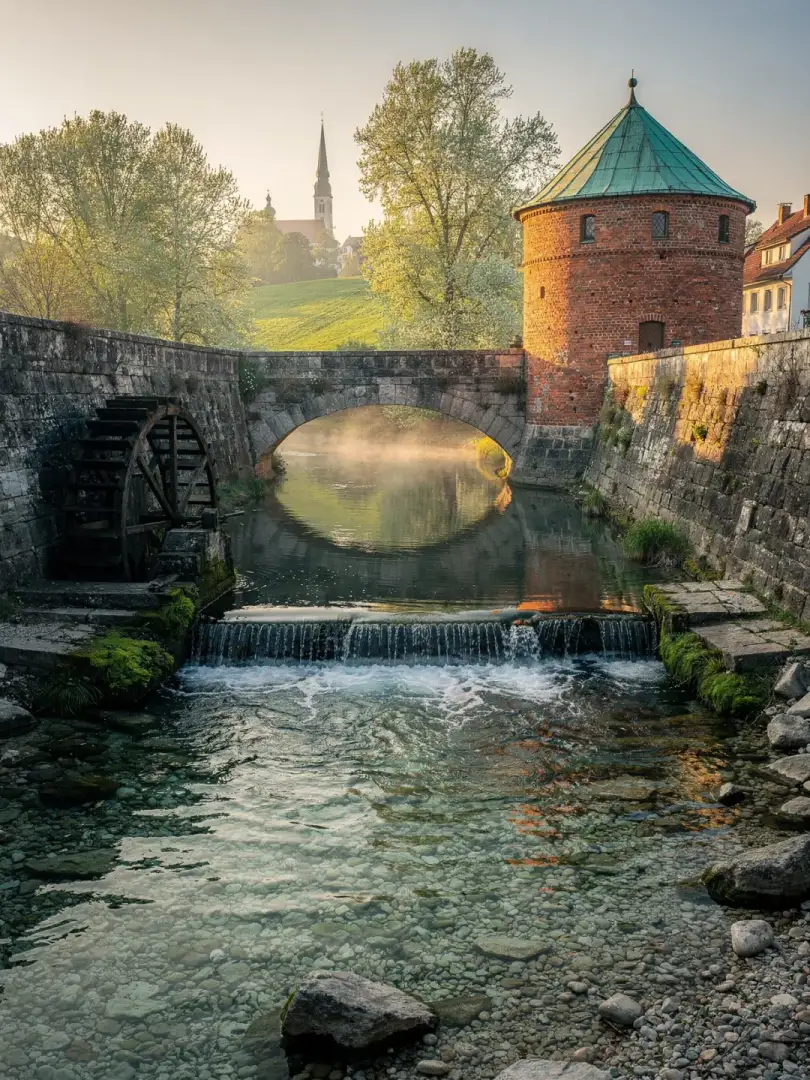
Augsburg's water comes from the Lech, and the city channelled it into canals early on. The historic water management system was declared a UNESCO World Heritage Site in 2019. It includes canals, water towers with pumping stations from the 15th century, three ornate fountains, and power plants that still generate electricity today. Most of the water is still drawn from the Lech at the Hochablass.
One detail matters for the beer: according to surviving sources, Augsburg separated drinking water from process water at the latest from 1545 onward. The Brunnenbach supplied clean water for the people, while the Lochbach served trades and crafts. At first, only a wooden wall divided the canal. Anyone brewing beer needed water in quantity, and it flowed through the city wherever it was needed.
How hard Augsburg's brewing water is remains deliberately unspecified here, since reliable measurements for individual breweries are lacking. In any case, almost all breweries treat their water today, for example by softening it. The idea that “water makes the style” held true mainly in earlier times, when brewers had to work with whatever the source provided.
In the Ries, the landscape looks entirely different. About 15 million years ago, a meteorite struck there, leaving behind an almost perfectly circular basin, in the middle of which lies Nördlingen. Breweries in the area speak of drawing their brewing water from deep within the Ries. This is a claim made by the businesses themselves; the water's composition is not specified.
For wheat beer, the water question is generally less decisive than for a Pils, since yeast and wheat malt shape the flavor more strongly than minerals. Soft water lets a Helles or Weizen come across as round and mild. Very carbonate-rich water, by contrast, would suit dark malts better. That's why Augsburg's brewers work primarily with raw materials and yeast rather than water.