Cold and slow
Yeast & Fermentation
The beers of this region are bottom-fermented, which has consequences for timing. Bottom-fermenting yeast works at low temperatures, typically between about 8 and 12 degrees Celsius, settles at the bottom of the tank once fermentation ends, and takes longer than ale yeast. This holds true for the Schwarzbier from Neuzelle just as much as for the pale lagers from Görlitz.
This yeast is a hybrid. Saccharomyces pastorianus arose from the crossing of the brewer's yeast Saccharomyces cerevisiae with Saccharomyces eubayanus, whose trace researchers found in Patagonia in 2011. Emil Christian Hansen isolated it as a pure culture in Copenhagen in 1883. The connection to Brandenburg is simply that the same yeast family sits here as it does in German lager everywhere.
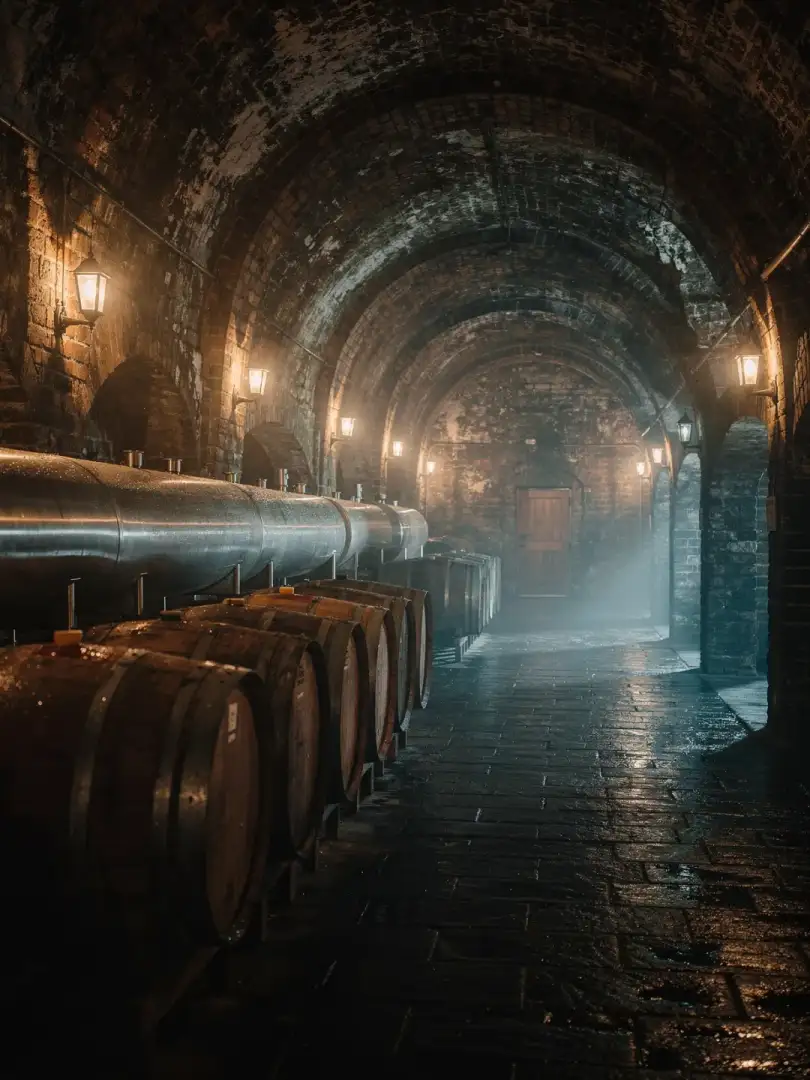
What's more interesting is what happens after fermentation. At Landskron, according to the brewery, the beer ages for about 40 days in the cellars built in 1869. Lagering means: at temperatures near zero, the young beer continues to mature, the yeast settles out, unwanted byproducts break down, and the beer becomes clearer and rounder.
For Schwarzbier and Porter, lagering time plays a second role too. Dark roasted malts taste sharp and somewhat rough at first, and the quiet time in the tank softens them. This is another reason why Bergquell and Neuzelle don't brew beers meant for quick turnaround. Beyond Landskron, we haven't been able to verify exactly how long each brewery ages its beer, so we won't claim otherwise.
None of these breweries ferment spontaneously or with mixed cultures. The classic Berlin-Brandenburg sour beer, Berliner Weisse, belongs to Berlin's beer culture and is told there.