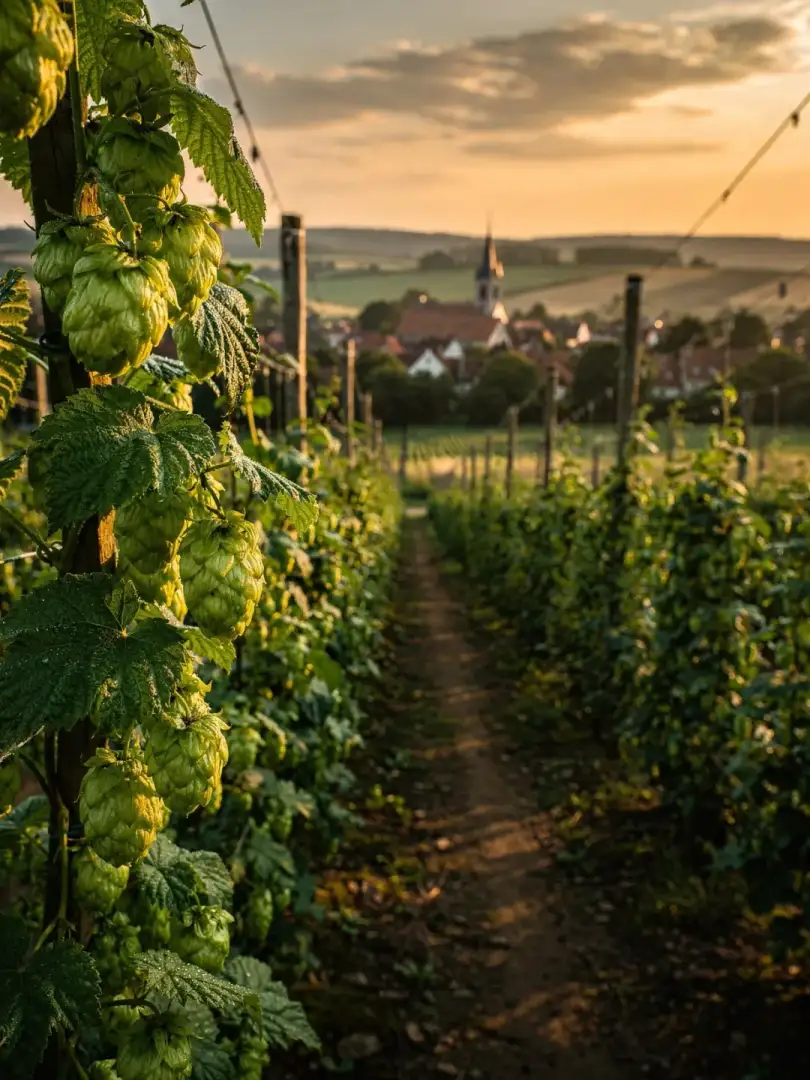
Elbe-Saale, bittering hops
Hops
Does hops grow in Brandenburg and the Lausitz? No significant cultivation serving these breweries is documented. The nearest German growing region is Elbe-Saale, spanning Saxony, Saxony-Anhalt, and Thuringia. Since 2014, hops from there have carried the protected geographical indication "Elbe-Saale Hopfen."
This region produces mainly Magnum and Herkules, two varieties high in alpha acid. Alpha acid is the compound in hops that transfers into the wort during boiling and gives beer its bitterness. Brewers using such varieties need only small amounts of hops to achieve strong bitterness, which suits a beer meant to taste of malt rather than smell of hops.
For Schwarzbier, the BJCP guidelines put the bitterness range at 20 to 35 IBU. IBU stands for International Bitterness Units and measures how much hop bitterness is in the beer. That's noticeable, but considerably less than in a robust Pils or an American IPA. Here, the roasted bitterness of the malt and the hop bitterness complement rather than compete with each other.
Aroma hops like the classic noble varieties are best used late in the boil. They contribute floral notes and a touch of herbs, and in a dark beer they quickly fade behind the malt. That's why brewers of Schwarzbier and Porter focus on rounded bitterness instead. This holds for Löbau, Görlitz, and Neuzelle alike, where malt character takes center stage. Exactly which varieties Neuzelle, Landskron, or Bergquell use isn't stated in verified sources, and we won't invent hop lists.