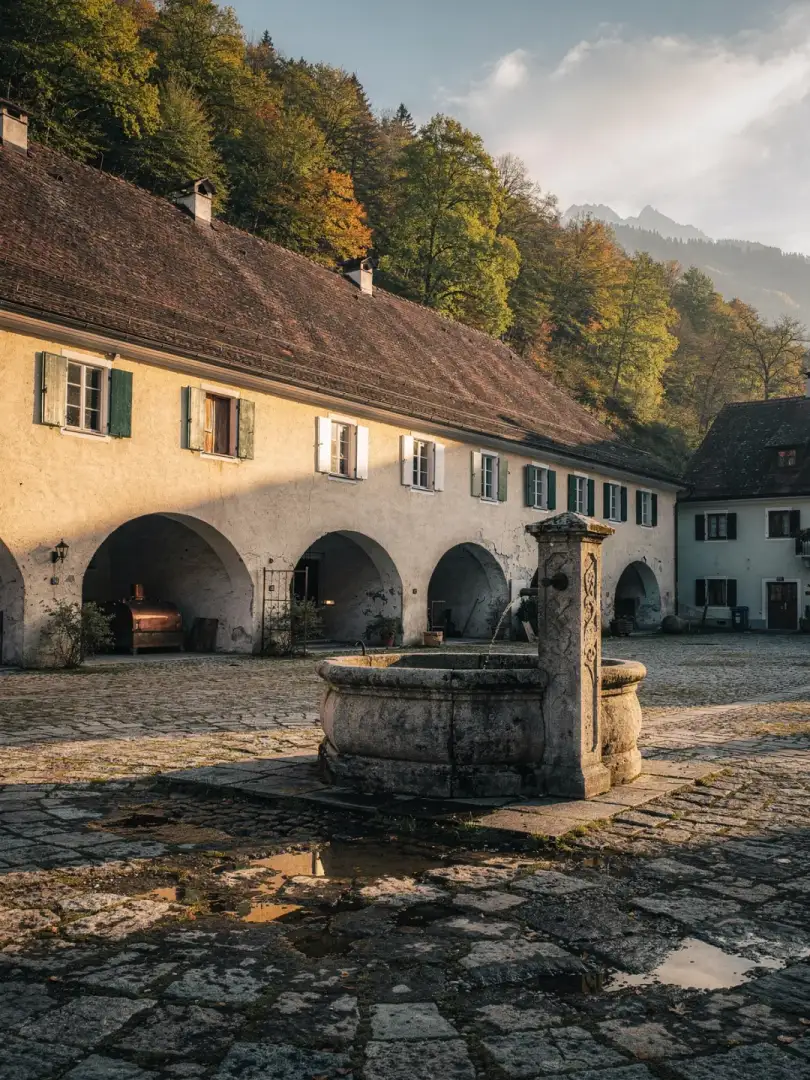
Duke and Archbishop
Region & History
Hofbräuhaus Traunstein traces its roots back to 1612, when Duke Maximilian opened a "Weisses Preyhaus" there, a state-run operation for brewing Weissbier. At the time, Weissbier was a ducal privilege: after the Degenberg line died out in 1602, Maximilian I had claimed the monopoly for himself. This gave Traunstein an early brewery that worked for the court.
In 1820 the brewery was privatized and began brewing other styles of beer as well. It has belonged to the Sailer family since 1896, when Josef Sailer from Lauingen bought the house. Large cellar systems were built into the hillside in the late 18th and early 19th centuries.
Heading east from Lake Chiemsee brings you into the Rupertiwinkel. The land between the Salzach, Saalach, and Teisendorf long belonged to the Archbishopric of Salzburg and was separated from Salzburg in 1816, becoming part of Bavaria ever since. That's why the breweries here once belonged to an archbishop rather than the Bavarian duke.
In Teisendorf, a "preuhaus in der Gassn" is documented as early as 1557. On May 28, 1666, Prince-Archbishop Guidobald Count von Thun und Hohenstein bought the brewery and turned it into a court brewery. Following secularization, Philipp Wieninger from Trautmannsdorf in the Bavarian Forest acquired it in 1813. According to the brewery, the family has run it ever since, now in its seventh generation.
The region's tourism promotion speaks of twelve traditional breweries, with three in Traunstein alone. There is no dedicated protected designation of origin for Chiemgau beer. What applies is "Bavarian Beer," registered as a protected geographical indication since 2001.