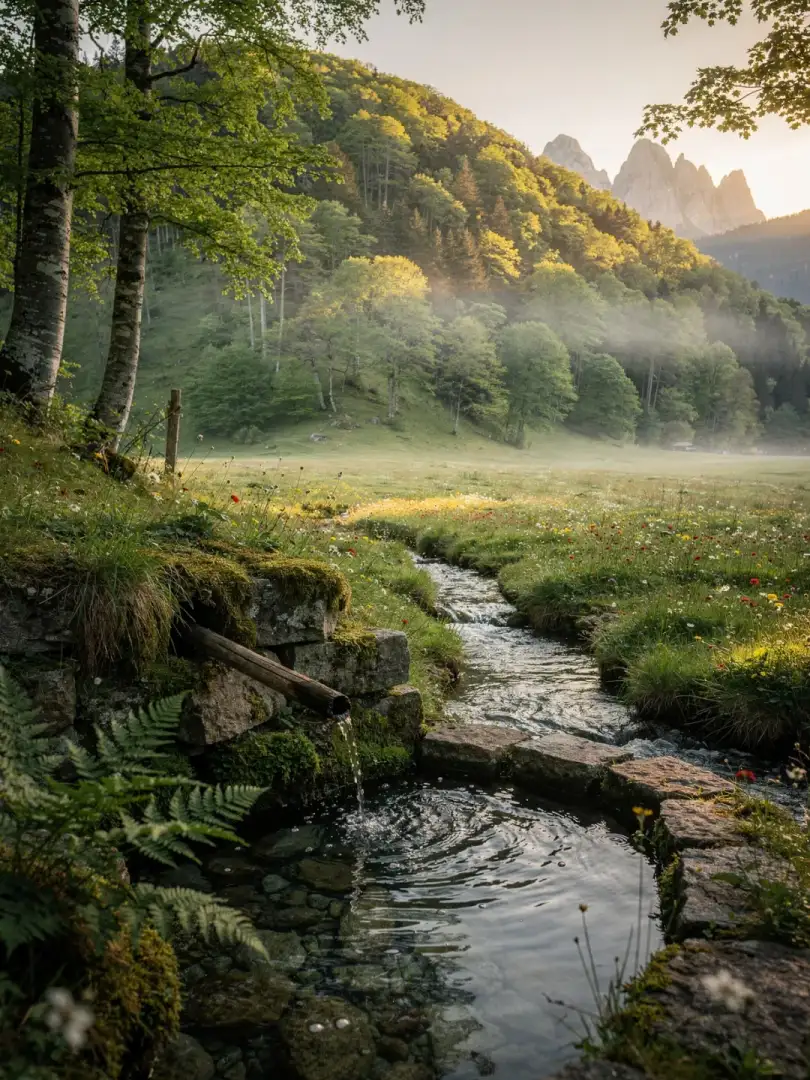
Springs at the Teisenberg
Water & Soil
At the foot of the Teisenberg, where the Wieninger brewery draws its water, you can see clearly what brewers value about mountain terrain. Rain and meltwater seep into the slopes and re-emerge as springs, clear and cool. According to the brewery, it secured the "Ramsauer Quelle" and the "Stacherl Quelle" through purchase and contracts in the 1960s.
The Chiemgau's subsurface is a legacy of the Ice Age. The Alps rise to the south, while moraine hills and gravel terraces left behind by a glacier follow to the north, with Lake Chiemsee sitting in the middle as a remnant of that ice. Groundwater flowing through such gravel layers gets filtered and stays cold.
What the water does to the beer depends on its dissolved mineral content. Hard, carbonate-rich water adds more sharpness to the bitterness, while soft water lets hops and malt come through more cleanly. Precise figures for each spring in the region aren't available for this journey, so no numbers are given here. In any case, nearly all breweries today treat their water.
The hillside itself is also a tool. In Traunstein, the Hofbräuhaus's cellars extend deep under the mountain, staying cool in summer and frost-free in winter. Before the invention of refrigeration, this was exactly why beer was stored into the hillside: it could age for weeks at a steady temperature.
The climate of the Alpine foothills sets the rhythm here. Long, cold winters once supplied the ice used to cool the cellars well into summer. The old brewing season, running from Michaelmas in September to St. George's Day in April, fits this pattern precisely.