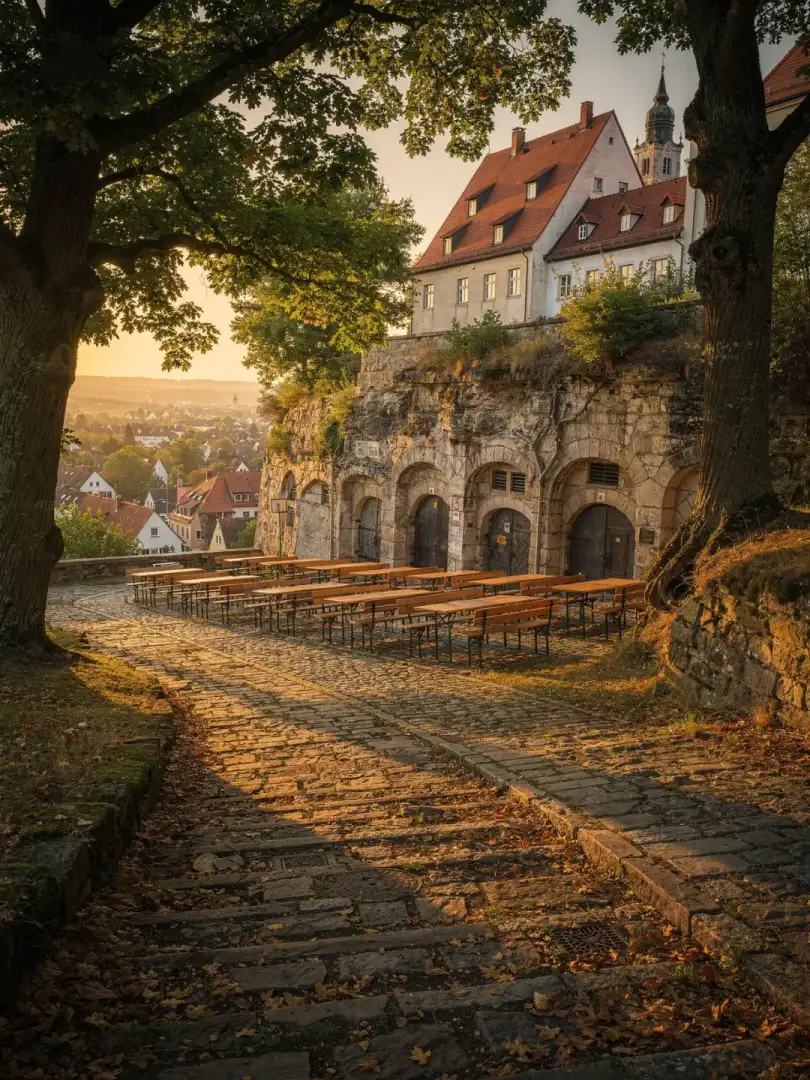
Cellar, export, hill
Region & History
Erlangen is the beer city on the Burgberg. According to local tradition, brewers began using the south side of this sandstone hill for their storage cellars as early as 1675. There, beer stayed cool even in the height of summer, long before refrigeration machines existed.
We know exactly when the Bergkirchweih began: on April 21, 1755, the council of Erlangen's old town decided to move the Pentecost market from the city center up to the Burgberg. That makes the festival a good 50 years older than Munich's Oktoberfest. Today, when locals talk about the "Berg," they mean both the festival and the hill itself.
In the 19th century, the city grew into a brewing stronghold, with as many as 18 breweries operating here. By the mid-century, Erlangen led Bavarian beer exports, ahead of even Munich and Kulmbach. Erlangen beer traveled throughout the German Empire, to Switzerland, France, England, and even overseas. In the US, "Erlanger" became synonymous with good beer.
Two names still define the city today. The Kitzmann brewery was founded in 1712 and has belonged to the Kitzmann family since 1833. Steinbach expanded significantly under Carl Steinbach starting in 1861, but had to close in 1923 during the years of inflation. With Carl von Linde's refrigeration machine, the cellar lost its edge, and the brewing trade shrank.
Erlangen beer has no protected designation of origin of its own; there's no entry for it in the EU register. As everywhere in Bavaria, the Reinheitsgebot (purity law) applies, with no sugar allowed, and the name "Bavarian Beer" has been protected since 2001. Kitzmann ceased operations in 2018, and the Kulmbacher brewery took over the brand. What remains are the cellars in the hill.