Hops from next door
Hops
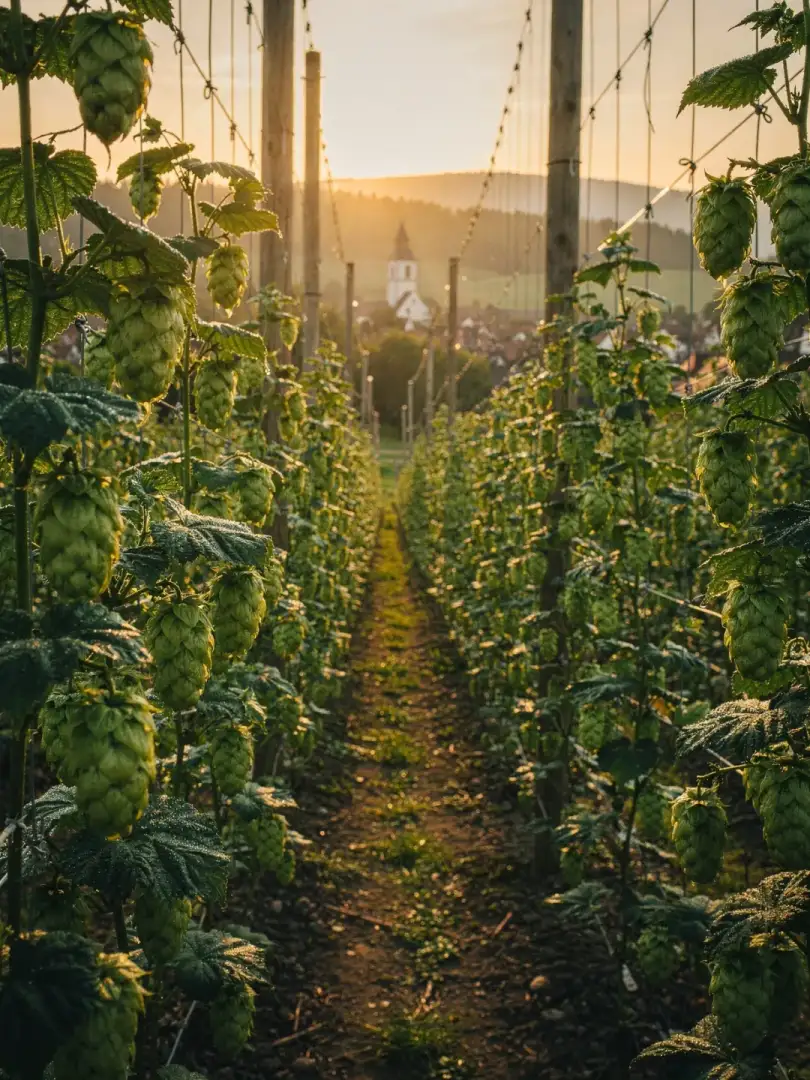
Hops aren't grown in Erlangen itself, but the city sits right in the middle of hop country. Spalter hops from the south have carried the EU's PDO seal since 2012, the only Franconian hop variety to do so, while Hersbrucker Spät grows in the Hersbrucker hills. A bit further south begins the Hallertau, Germany's largest hop-growing region.
For a beer meant to age in the cellar for a long time, hops serve a practical purpose. Their bittering compounds guard against microbes and keep the beer fresher for longer, which mattered for exports over long distances. At the same time, hops give the Märzen its dry backbone, so the malt's sweetness never feels cloying.
How bitter is an Erlangen Kellerbier? The style guidelines list 16 to 22 IBU for Helles and 18 to 24 IBU for Märzen. IBU stands for International Bitterness Units, the measure of bitterness. By comparison, a German Pilsner runs between 22 and 40, making it noticeably more assertive.
Which varieties Erlangen's brewers used historically isn't fully documented. Today, many breweries in the region use the classic noble aroma hop varieties, prized for their fine, spicy, floral, and slightly herbal character. That suits the restrained style of Kellerbier, where hops accompany rather than lead.
Anyone who takes a sniff of a glass of Bergbier at the Bergkirchweih won't find a burst of citrus, but rather a quiet hint of hay and herbs. The hop character sits in the finish, delivering a clean close. That's by design: beer from the Burgberg should always leave room for the next glass.