Cellar, Kerwa, Brotzeit
Food & Beer Culture
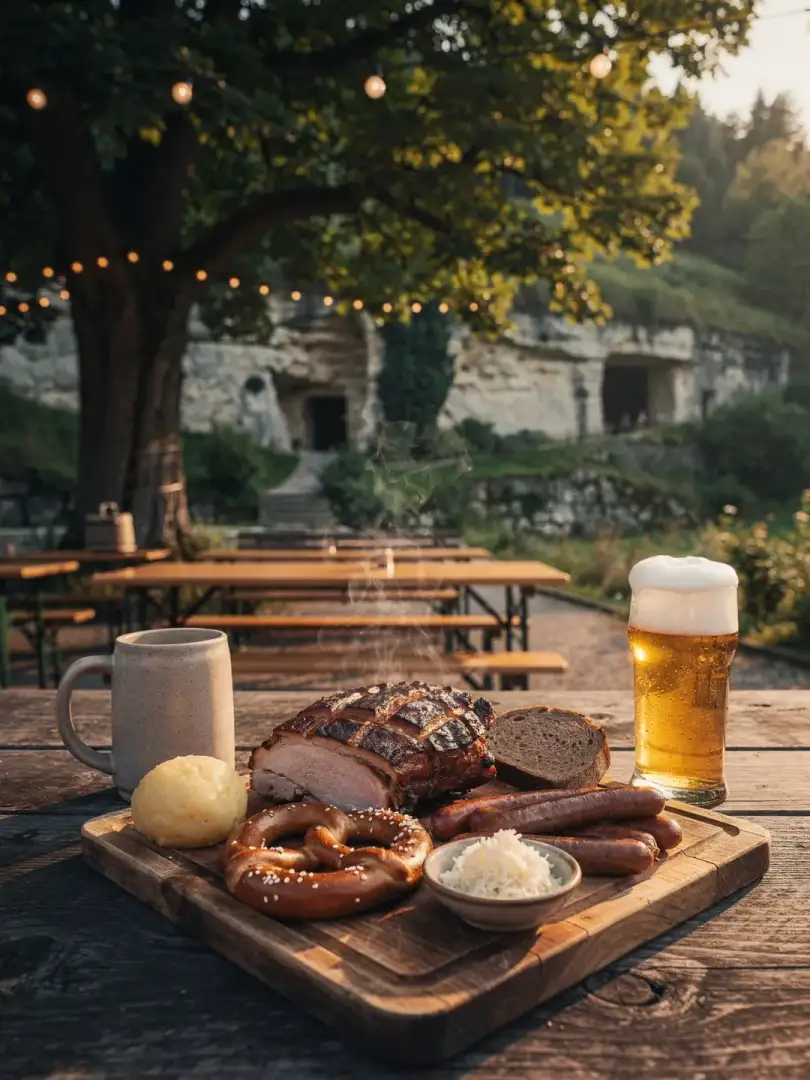
What do you eat with Kellerbier? Franconian Switzerland answers with Brotzeit: farmhouse bread, bratwurst, Presssack (head cheese) with onions and vinegar, plus horseradish. The beer cuts through the fat, the malt sweetness balances the sharpness, and together it all fills you up without weighing you down.
For lunch, there's Schäufele, roasted pork shoulder with crackling, served with a dumpling and gravy. The beer holds its own against it without fading into the background. The Wiesent river and its tributaries supply the trout, served at the local inn either pan-fried or poached.
The heart of the local beer culture is the cellars. You sit at wooden tables under old chestnut trees, with Brotzeit from your own rucksack or from the innkeeper, and the beer arrives by the Seidla. In Forchheim, the Kellerwald holds 23 beer cellars spread across roughly 20,000 square meters, and the town calls it the largest beer garden in the world.
That's also where the Annafest is celebrated. It traces back to the Annakapelle in Unterweilersbach, consecrated in 1516, which drew pilgrims from Forchheim. On the way back, they'd rest in the Kellerwald. Since 1840, when the local marksmen's club moved their festival here, it's grown into a folk festival held around July 26th, drawing crowds estimated at up to 500,000 visitors.
Those who prefer hiking can follow the Fünf-Seidla-Steig near Gräfenberg and Weißenohe, a trail roughly 18 kilometers long. Five breweries line the route: Elch-Bräu in Thuisbrunn, Hofmann in Hohenschwärz, Lindenbräu and Friedmann in Gräfenberg, and the Klosterbrauerei Weißenohe. Information boards along the way explain how the beer is made.
Then there's the Kerwa, the village church fair, with dancing, cake, and the cask the innkeeper taps open. Enjoyed in moderation, the Seidla becomes part of the conversation, and most people stop at a second.