Seal & Pickers
Region & History
North of Munich begins the largest contiguous hop-growing region in the world. The Hallertau lies there, spreading across parts of the districts of Pfaffenhofen, Freising, Kelheim and Landshut. Mainburg and Wolnzach are considered its best-known hop towns.
According to trade media, around 17,100 hectares here grow roughly 83 percent of all German hops. Beer is also brewed in the area, but here the plant comes first: brewing happens on a larger scale elsewhere, but hardly anywhere is as much hop planted.
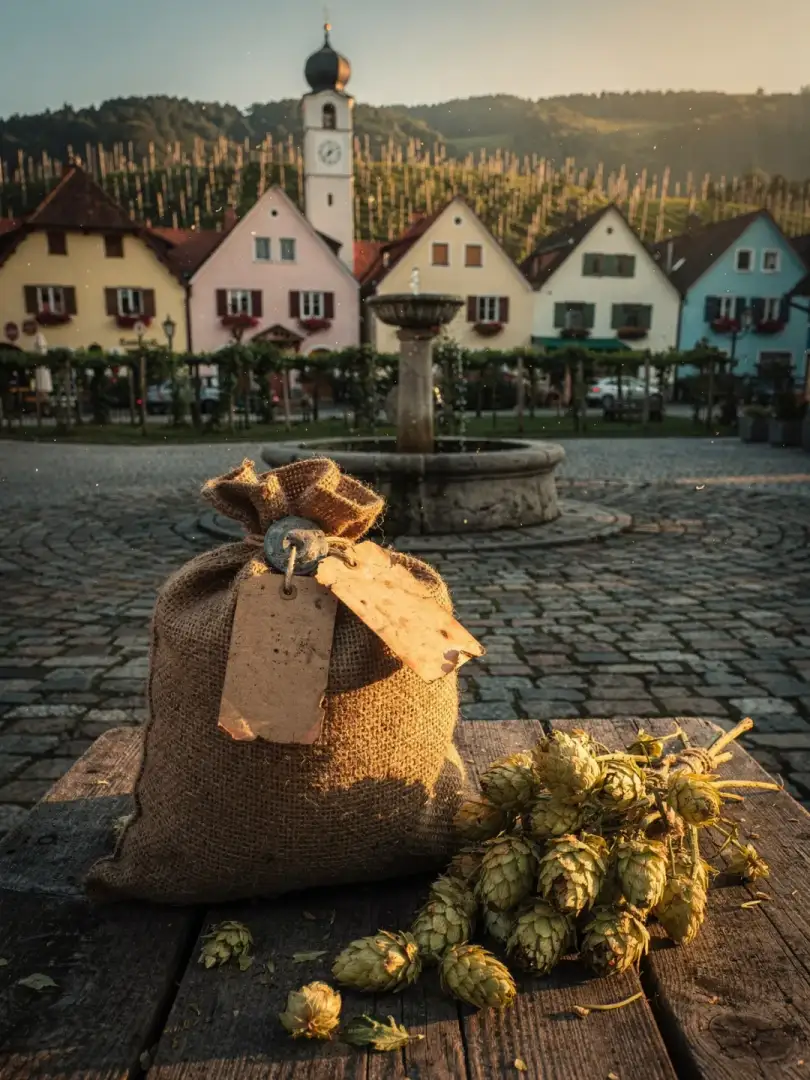
The region earned its reputation with a piece of lead sealing. In 1834, the market town of Wolnzach decided to seal its hops and sell them with accompanying papers, so buyers could recognize good quality. The hop seal was a mark of origin on the sack, long before EU protected names existed. Later, more than a dozen sealing districts emerged in the Hallertau.
Today the hop carries its own name protection. Since 2010, "Hopfen aus der Hallertau" has been registered as a Protected Geographical Indication (PGI). This applies to the plant, not to beer: there is no EU-protected "Hallertauer Bier", only "Bayerisches Bier", which has held PGI status since 2001.
That hops belong in Bavarian beer is set down by an old rule. The 1516 territorial ordinance names "barley, hops and water"; yeast was only explicitly added in Bavaria in 1910. This gave hop farmers a steady buyer right in their neighborhood.
How laborious the harvest once was is shown by the German Hop Museum in Wolnzach, founded in 2002 and opened in 2005. Figures of hop pickers stand there: thousands of harvest workers once picked the cones by hand. Around twenty breweries operate in the region today, including Ziegler Bräu in Mainburg, the only one of formerly six still brewing.