Loam & Drought
Water & Soil
Hops are thirsty. In spring, the plant sends up vines several meters long and draws the water it needs from the soil the Hallertau provides.
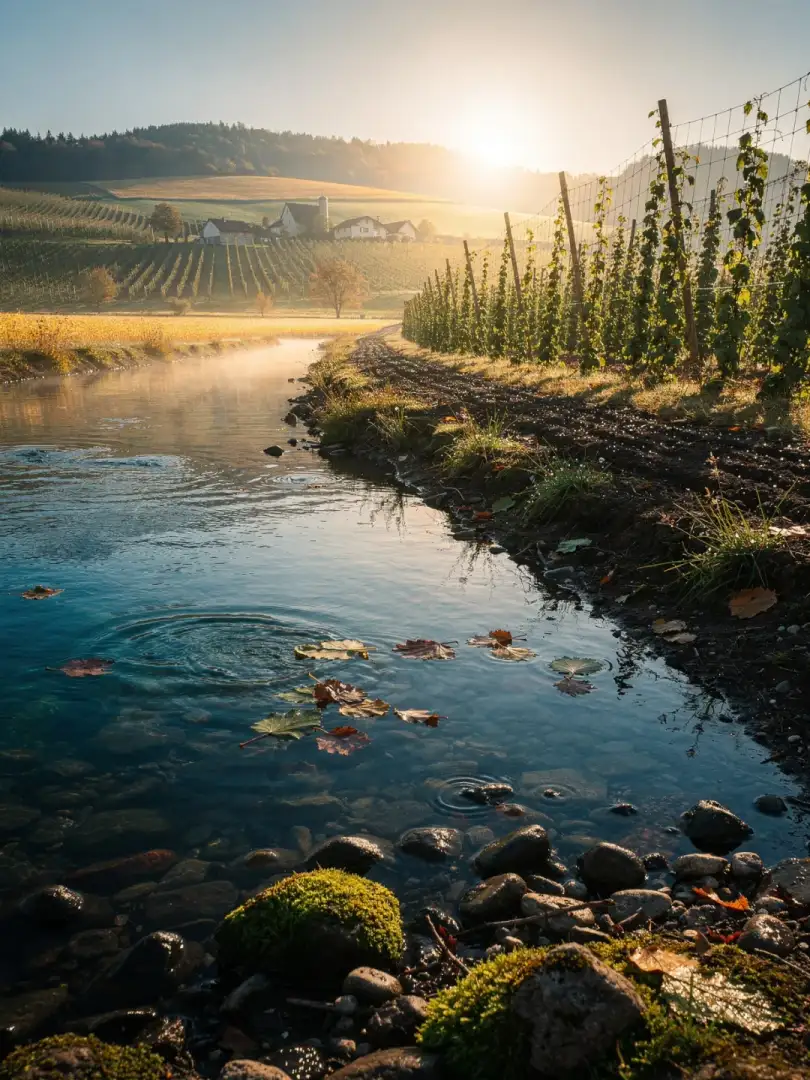
The landscape consists of gentle hills of the Tertiary Hills, crossed by small rivers such as the Ilm and the Abens. On the hilltops lie loam and loess soils, deep and fine, which store rain without waterlogging. Such deep soils are especially favored by hop roots.
This region also feels the drought. Trials by the Weihenstephan-Triesdorf University of Applied Sciences in 2025 showed that yields of Hallertauer Tradition dropped by nine to 27 percent depending on soil moisture. Where the soil is drier, the loss is greater, and a hot summer can decide the whole harvest year.
The region has only an indirect connection to brewing water, since here the plant is what counts. We therefore don't cite reliable measurement values, and that's no great gap: nearly every brewery treats its water today, through softening, salt addition or reverse osmosis.
Still, a connection remains. More sulfate in the water makes hop bitterness taste sharper and drier, more carbonate makes it softer and rounder. That's why English brewers in sulfate-rich Burton upon Trent added gypsum when they wanted a hop-forward ale.
After harvest, the hops lie cool and dry in the sack, since moisture and warmth would quickly degrade their aromas. In Mainburg, the Hop & Beer Experience Trail leads from Griesplatz all the way to the beer garden of Ziegler Bräu at the foot of the Salvatorberg.