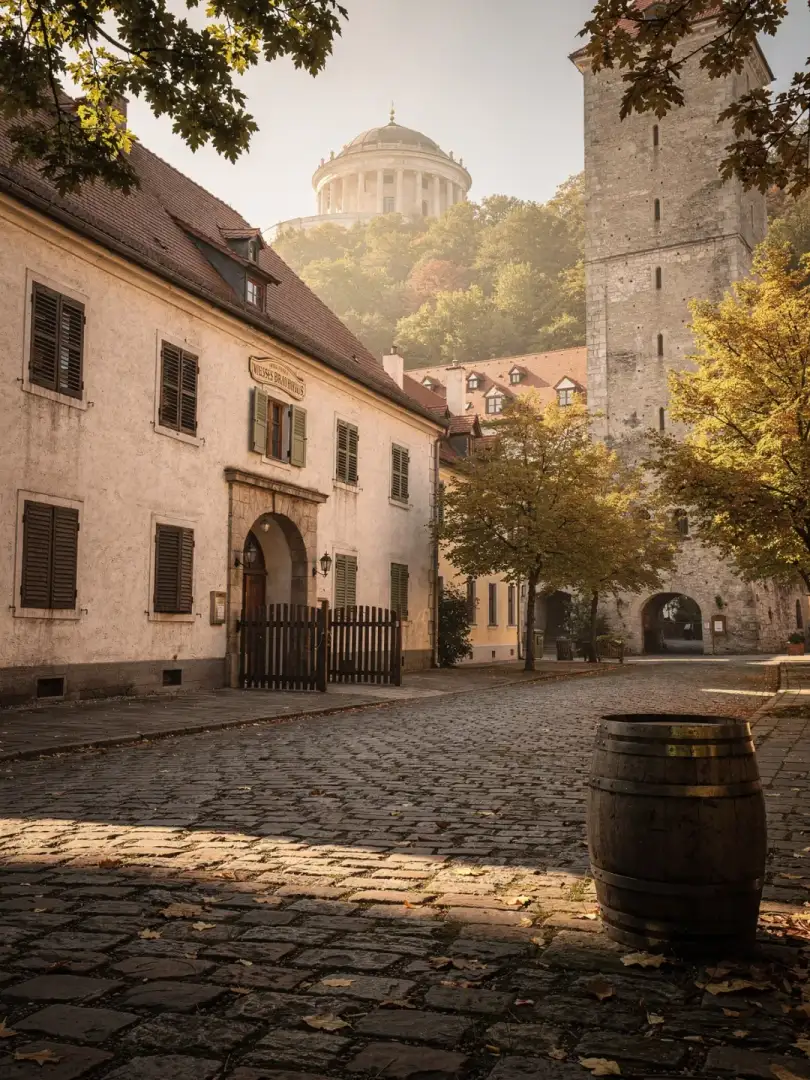
Monastery & Wheat Beer Privilege
Region & History
Where the Danube has to squeeze between sheer Jurassic limestone cliffs near Kelheim lies Kloster Weltenburg, whose brewery traces its roots back to 1050. According to tradition, the monastery itself goes back to the Irish-Scottish wandering monks Eustachius and Agilius, said to have arrived from Luxeuil around 600.
Whether brewing has really continued uninterrupted in Weltenburg since 1050 is a claim made by the brewery itself, which bills itself as the oldest monastery brewery in the world. Klosterbrauerei Weltenburg belongs to the Benedictine abbey and has been linked to the Bischofshof brewery in Regensburg since 1973. Since Bischofshof is set to stop brewing at the end of 2026, the Weltenburger and Bischofshof brands will pass to Schneider Weisse in Kelheim on 1 January 2027; brewing will continue at the monastery itself.
The second story unfolds in Kelheim's old town. Wheat beer never fit the Reinheitsgebot of 1516, which recognized only barley, so brewing it was reserved for the privileged: from 1548 the Degenberger family held the right, and after that line died out in 1602, Duke Maximilian I claimed the Weißbierregal, the exclusive right to brew wheat beer, for himself.
Maximilian turned the privilege into a state enterprise. According to Schneider's own account, in 1607 he had the first of his new Weiße Bräuhäuser outside the capital opened in Kelheim. The building still stands today.
In 1872, Georg Schneider and his son took over the Weißes Brauhaus in Munich, and Kelheim joined the operation in 1927. When the Munich brewery was destroyed in 1944, production moved entirely to Kelheim, where the Schneider family still brews today.
There's no dedicated Kelheim geographical indication. The 2001 PGI Bayerisches Bier applies to the entire Free State of Bavaria, Kelheim included, while Münchener Bier is a separate protected name that doesn't apply to these beers.