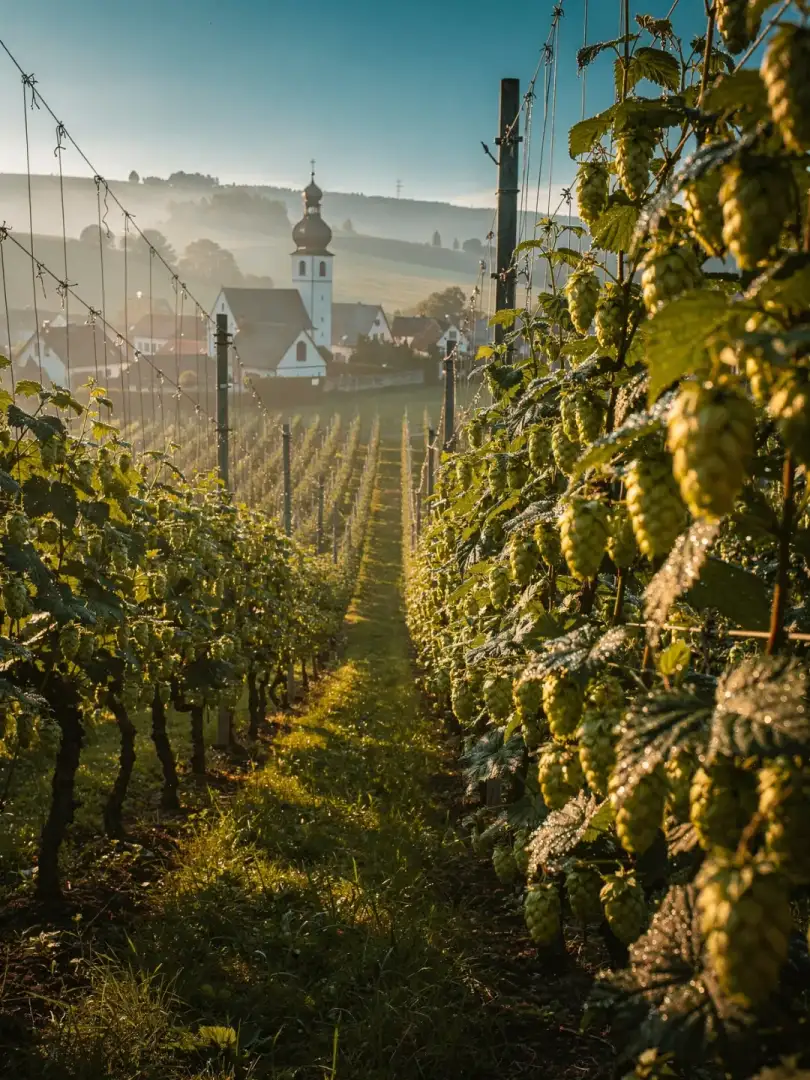
The Hallertau Next Door
Hops
Where do the hops for Kelheim's beer come from? Practically next door. The Hallertau, the largest contiguous hop-growing region in the world, stretches into Kelheim district. Spanning roughly 17,000 hectares, it supplies well over four-fifths of all German hops.
Hallertau hops have carried an EU PGI seal since 2010. Weltenburg describes its hops as coming from the Hallertau right outside the monastery's gates. The breweries don't disclose exactly which varieties go into the kettle, so we'll stick to the varieties typical of the region.
Classic aroma varieties here include Hallertauer Mittelfrüh, Hallertauer Tradition, and Perle, alongside Magnum and Herkules, which mainly contribute bitterness. Hops added early in the boil deliver bitterness; added late, they deliver aroma — floral, spicy, with a hint of hay.
Bitterness is measured in IBU, a figure for the bittering compounds in beer. By style guidelines, a Weißbier sits at just 8 to 15 IBU, a Dunkel at 18 to 28 — modest numbers compared to a Pils. At Schneider Weisse and in Weltenburg, the hops are thus deliberately kept understated, and the scent of the Hallertau drifts right through Kelheim's beer gardens.
This is intentional. In wheat beer, hops are meant to stay in the background so they don't mask the banana and clove notes from the yeast. In Dunkel, they provide a counterweight to the malt sweetness so the beer doesn't turn cloying.