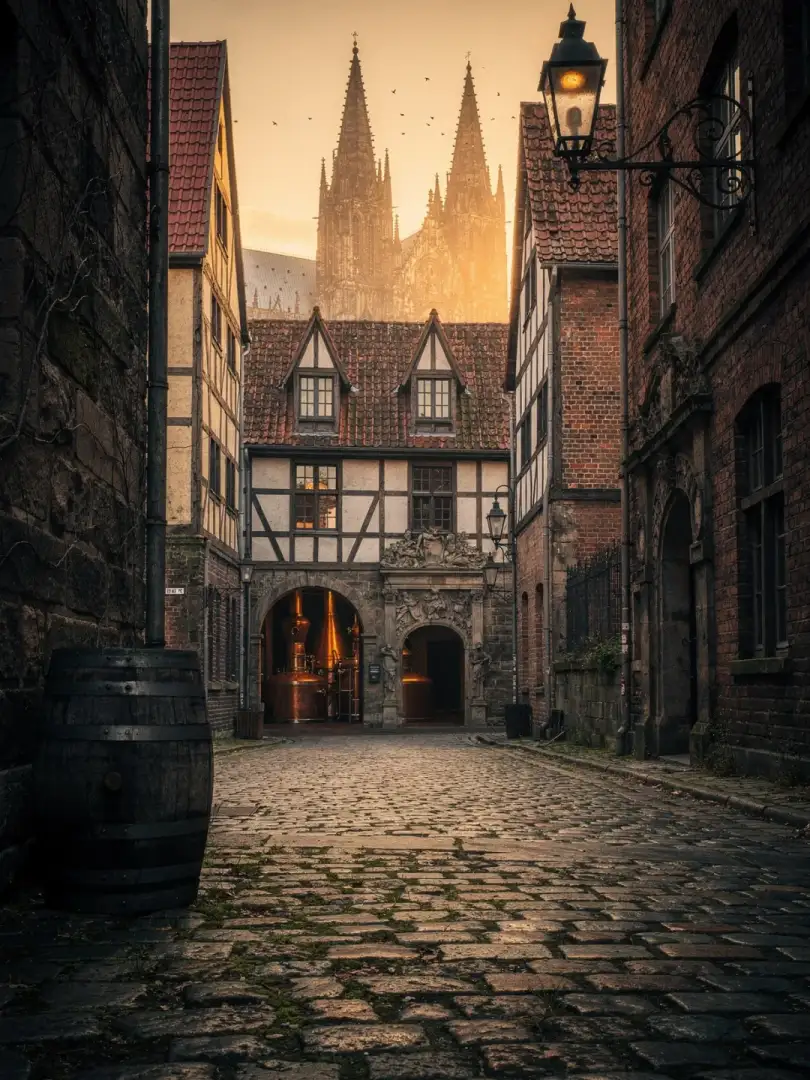
Convention & Brewhouses
Region & History
Why can't just any pale beer call itself Kölsch? Because Cologne's brewers agreed on a common rule on March 6, 1986. At the time, 24 breweries signed the Kölsch Convention, a voluntary agreement from the Cologne Brewers' Association. Under it, Kölsch must be pale, clear, top-fermented, and highly attenuated, meaning the yeast has largely consumed the sugar in the wort. Add to that a pronounced hop character, classification as a Vollbier (full-strength beer), and serving in the Stange glass.
Legal protection followed later. Since the EU regulation of November 25, 1997, 'Kölsch' has held Protected Geographical Indication (PGI) status. The claim that 'Kölsch may only be brewed in Cologne' is only half true: it's permitted in Cologne itself, as well as at those breweries outside the city that were already brewing Kölsch before the Convention.
The style is younger than its reputation suggests. For a long time, the pale beer was called 'Wieß' (from 'weiß,' meaning pale), and the name Kölsch only became established in the early 20th century. Before that, Cologne drinkers mostly favored darker top-fermented beers. When bottom-fermented pale beers from Pilsen and Bavaria came into fashion, the city developed a pale beer of its own that stuck with the traditional top-fermenting yeast.
The houses that define the cityscape today are often not as old as you'd think. Reissdorf cites 1894 as its founding year, Früh 1904, Gaffel 1908. The Sion brewery claims, by its own account, beer brewed as far back as 1318. That claim should be read as the producer's own account rather than as unbroken, documented company history.
Today, by common estimates, around a dozen breweries still make Kölsch, ranging from large private breweries to small houses with their own taproom. Some now belong to major beverage conglomerates, while others have remained family businesses. What unites them all is simply that the Convention applies to every one.