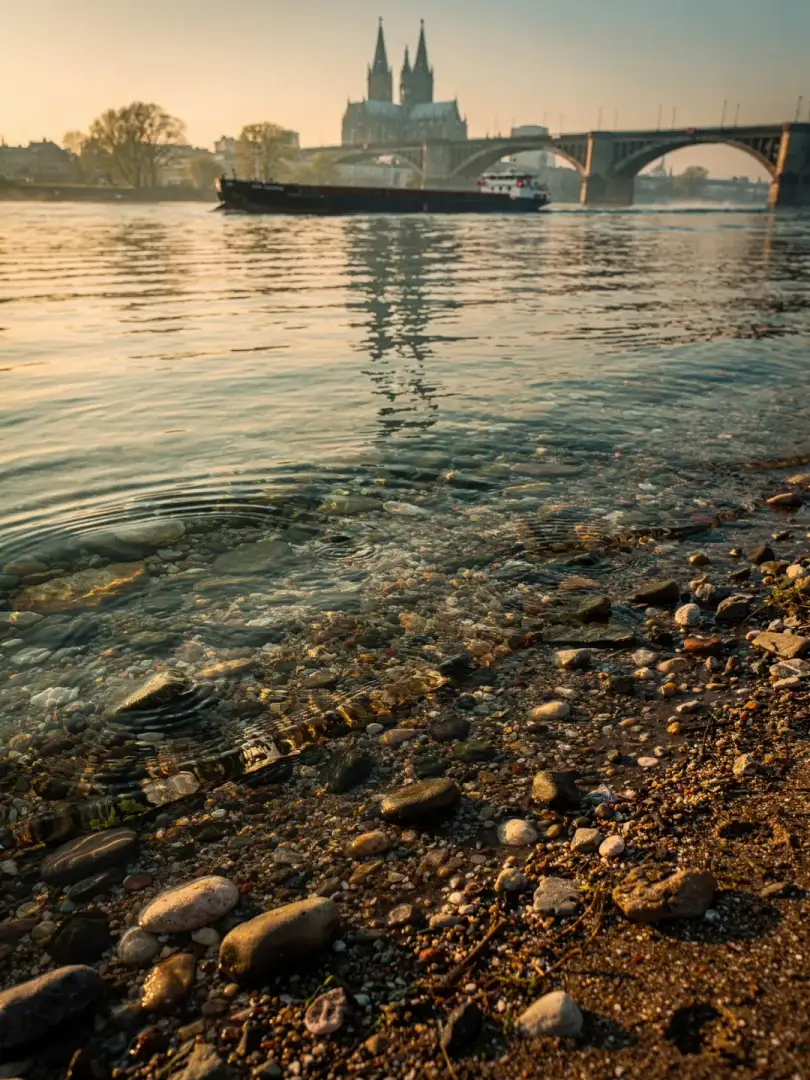
The Rhine, Cologne Lowland
Water & Soil
Cologne lies on the Rhine in the Cologne Lowland, a flat landscape whose subsoil consists of gravel, sand, and loam deposited by the river over millennia. There's no talk here of rock springs or sandstone cellars like in Franconia. Groundwater sits close to the surface, and the brewhouses stand right in the middle of a big city.
The city's tap water, according to common accounts, comes largely from riverbank filtrate of the Rhine along with groundwater. Riverbank filtrate means river water seeps through gravel and sand into the ground and is purified in the process. Each brewery treats its own water, which is why hardness levels differ from house to house.
Why does this matter? Hard water with a lot of bicarbonate (dissolved lime compounds that raise the acidity of the mash) makes the bitterness of a pale beer harsh and dull. Anyone wanting a clear, refined beer like Kölsch therefore usually lowers these levels or blends the water accordingly. The water itself stays in the background, letting the beer come across clean, soft, and dry.
Storage, too, is tied to place. After fermentation, Kölsch matures cool and slow in the tank, not in rock cellars like many Bavarian beers. In the brewhouses of the old town, the taps today often stand right next to the vats. The distances are short, the cask is tapped on site, and the beer arrives fresh in the Stange. So anyone standing at the tap at Früh am Dom or at Gaffel is drinking Kölsch in the very city where it's brewed.