Brought from Far Away
Hops
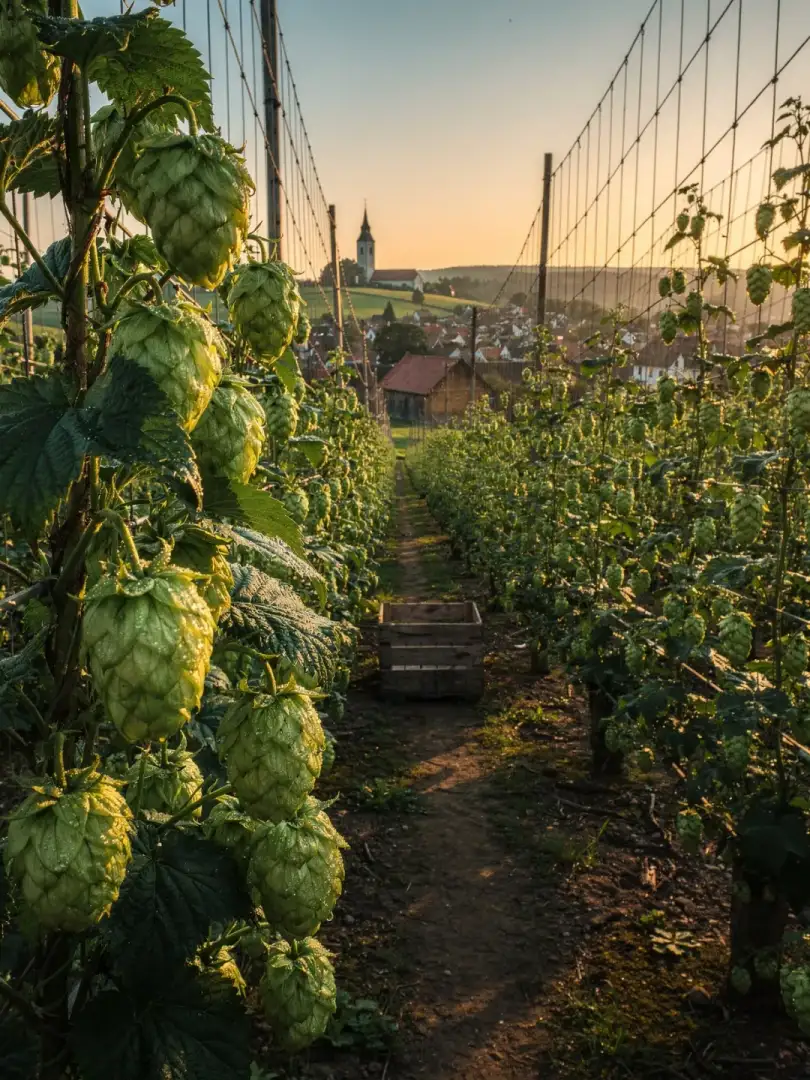
No hops grow in any significant amount around Kulmbach and Bayreuth — at least, no larger growing area is documented there. Brewers source them from Germany's established hop-growing regions. Kulmbacher Bier and Maisel's Weisse are therefore made with hops from farther afield. That's normal, since hops only thrive where soil, warmth and rainfall align.
The largest growing region is the Hallertau. According to the BarthHaas Report, Germany had a total of 18,962 hectares under hop cultivation in 2025, with around 17,129 hectares — roughly 83 percent — in the Hallertau. Franconia is also home to Spalt, whose hops are protected as a PDO. Which varieties individual breweries in this region choose is stated by each house; none is invented here.
What do hops do in beer? They supply bitterness, which offsets the sweetness of the malt, and they bring aroma. Bitterness is measured in IBU, a unit describing the concentration of bittering compounds in the wort. The higher the number, the more bitter the beer can taste, provided the malt doesn't soften it.
The differences across the region can be pinned down in numbers. A Weissbier Hell sits at 8 to 15 IBU according to BJCP, making it barely bitter at all. An Eisbock reaches 25 to 35 IBU. Yet because it carries so much malt, it still tastes sweet and round rather than sharp.
In Weissbier, aroma comes from the yeast, not the hops. Banana and clove arise during fermentation, while the hops stay in the background. It's similar with Bockbier: the hops are meant to support the malt, not mask it.