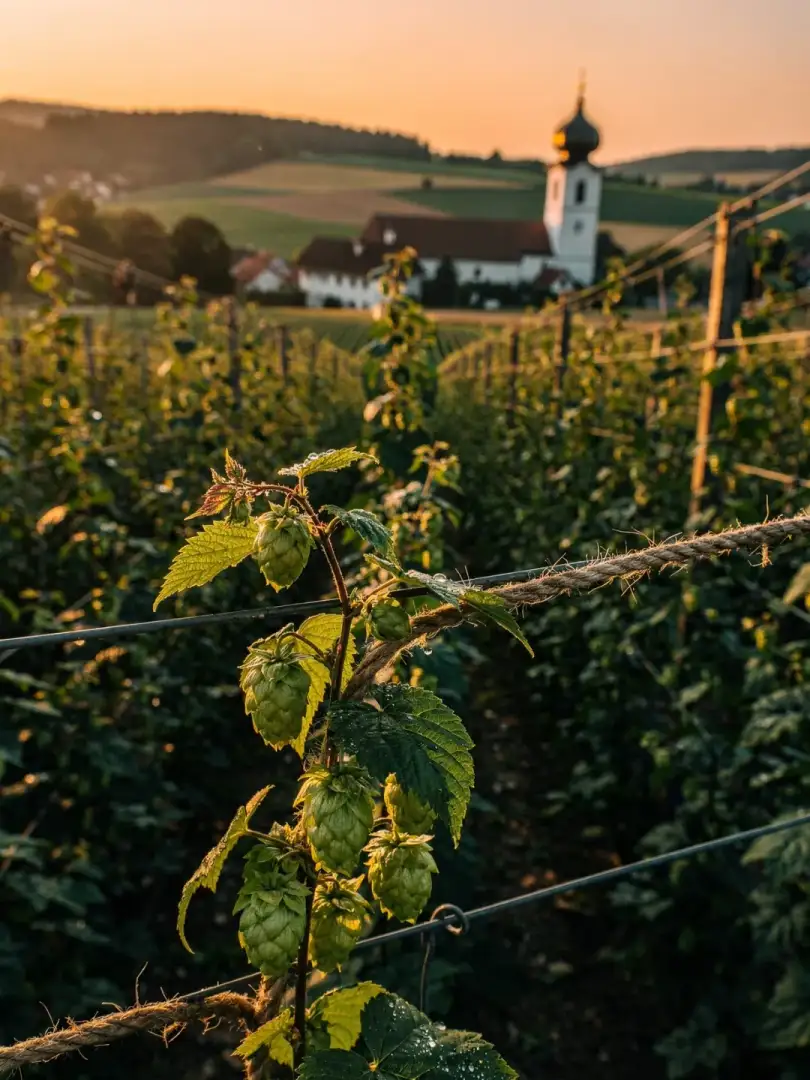
Hallertau Next Door
Hops
Little hops grow in the Isar Valley itself, but the Hallertau is within easy reach. It's the largest contiguous hop-growing region in the world, stretching northwest of Landshut between Freising and Mainburg. This is where the hops favored by the city's brewers come from.
According to the latest BarthHaas report, 18,962 hectares were under hop cultivation in Germany in 2025. Of that, roughly 17,000 hectares belong to the Hallertau, by far the largest share. Hallertau hops carry a protected designation of origin (PGI), something that, unlike beer, Landshut itself doesn't have.
Landshuter Brauhaus lists Hallertau aroma hops from certified organic farming for its Bio Hochzeits Weisse. Aroma hops go into the kettle late and bring fragrance rather than bitterness, think hay, herbs, and blossom. Bittering hops are boiled early and provide the dry finish.
The numbers show just how much balance matters for Helles and Weissbier. A Helles, per style guidelines, has only 16 to 22 bitterness units, and a Weissbier usually even less. Hops are meant to support the malt here, not cover it up, a very different approach from a boldly hopped Pils.
At harvest in August and September, the cones are picked in the Hallertau, dried, and pressed into pellets or extract. Brewers in Landshut source them from there and dose them very sparingly. The result is a hop aroma that leans more toward hay and herbs than citrus.