Cold Fermented
Yeast & Fermentation
Is Pils top- or bottom-fermented? Bottom-fermented. The yeast works at around 8 to 12 degrees Celsius and settles to the bottom of the tank at the end of fermentation. This produces clean-tasting lagers free of fruity notes. The yeast itself is a hybrid of two species, Saccharomyces cerevisiae and Saccharomyces eubayanus.
The process takes longer than with top-fermented beers. After primary fermentation comes lagering, during which the beer matures and clarifies in cold tanks. The English word "lager" comes directly from the German word for "to store." Depending on the brewery, this takes several weeks—only rough figures can be given, since there's no single standard.
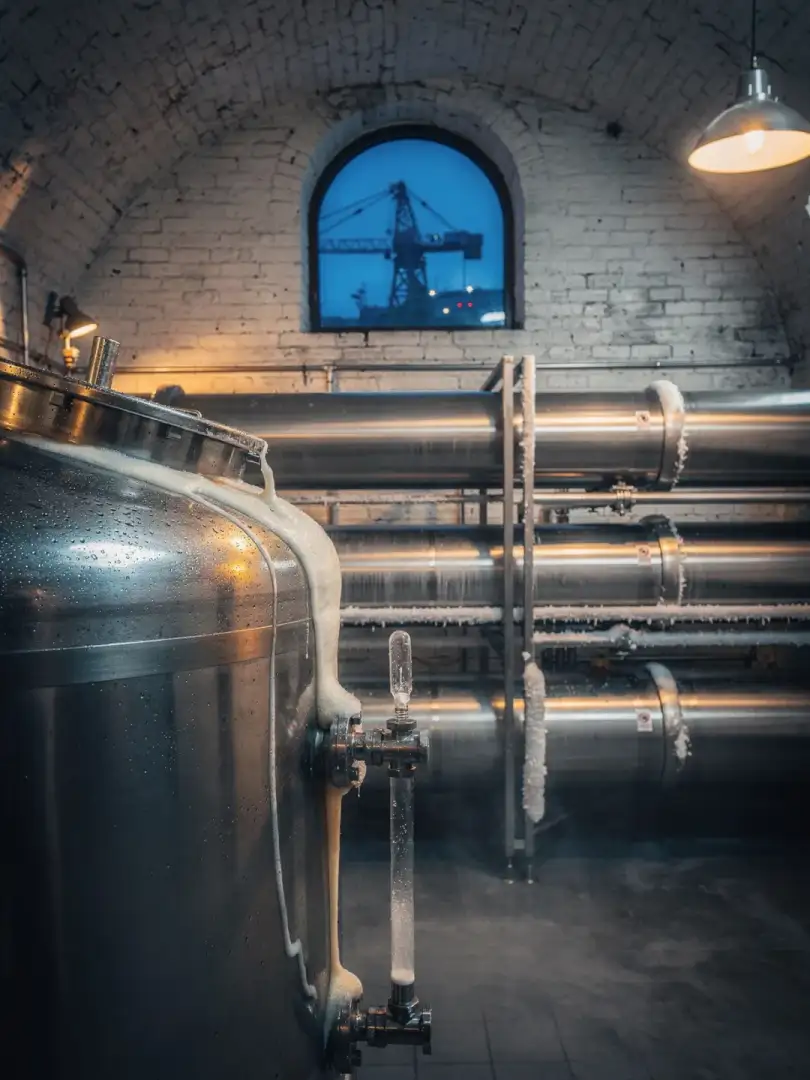
In Lübz, Rostock, and Dargun, this happens in steel tanks, as it does in all the region's larger breweries. According to its operator, the brewery in Dargun received a new brewhouse, fermentation and lagering cellar, along with a yeast propagation facility, in 1992, designed for an annual output of around 350,000 hectoliters. Yeast propagation means the brewery cultivates its own yeast in-house, ensuring every batch tastes the same.
Alongside Pils, the Stralsund brewery also produces a Keller-Bier that, according to the brewery, stays naturally cloudy. Unfiltered means the yeast and fine sediment remain in the glass. This gives the beer a rounder, somewhat breadier character, though it doesn't keep as long.
Cooling today is handled everywhere by refrigeration systems, not ice from the lakes. This allows fermentation temperature to be controlled with precision, down to the degree—and that's the real advantage modern brewing has over the old cellars of the Hanseatic era.