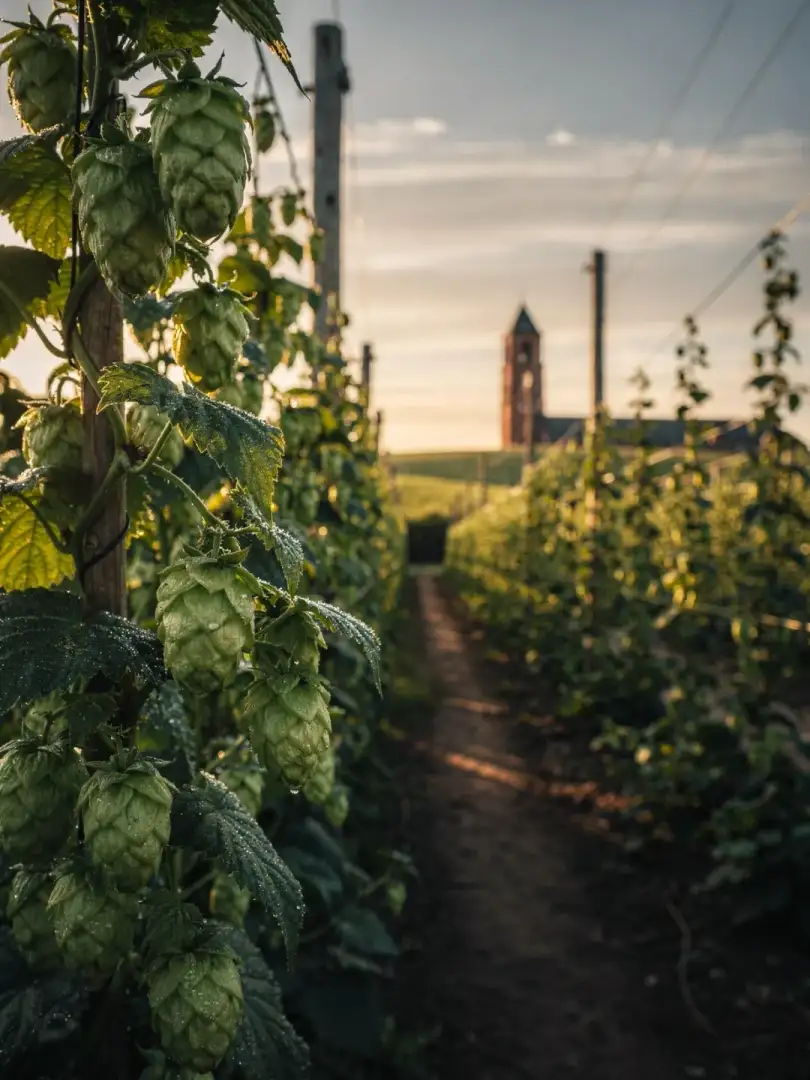
Hops from Elsewhere
Hops
Practically no hops grow in any meaningful quantity in Mecklenburg-Vorpommern. Germany's major growing regions lie elsewhere. The Hallertau in Bavaria covers around 17,129 hectares, about 83 percent of Germany's total hop acreage, while the Elbe-Saale region in Saxony-Anhalt and Thuringia accounts for roughly 1,550 hectares. The hops for the coast's beers come from there, from the south and east.
Pils relies on hops more than any other flagship beer in the region. They deliver the bitterness you notice at the end of the sip, and when added late in the boil, they also bring aroma—herbs, flowers, or grass. How much of that comes through in the glass is measured in bitterness units: a German Pils, by style guideline, sits at 22 to 40 IBU, the unit for International Bitterness Units.
A distinction is made between bittering hops and aroma hops. Bittering hops like Magnum or Herkules are rich in alpha acid, the compound that creates bitterness during the boil. Aroma hops like Perle or Hallertauer Mittelfrüh carry less of that but offer finer, more delicate scents. Most Pils brewers blend both, since a purely bittering hop tends to taste flat, while a purely aromatic hop makes the beer expensive.
Exactly which varieties go into Lübzer, Rostocker, or Darguner isn't consistently disclosed by the breweries. So we won't state anything we can't verify. What is certain is that the coast's beers are mostly pale, dry, and distinctly hop-forward. If you like bitterness, you're in the right place; if you're after sweetness, you'd do better reaching for a Weissbier from the south.