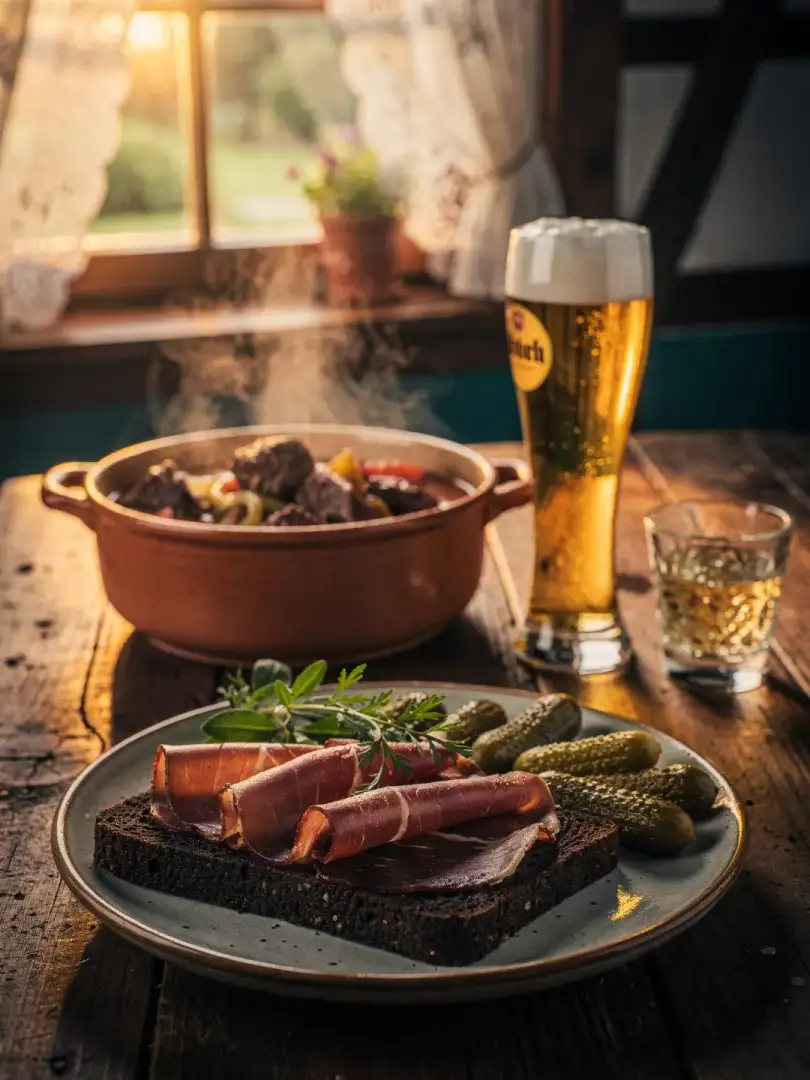
Töttchen and Ham
Food & Beer Culture
What do people eat with Münstersch Alt? Töttchen, a ragout traditionally made from veal in a tangy sauce with onions. The sauce's light acidity plays well against the mild fruitiness of the Alt. Pfefferpotthast also appears on many menus, a beef stew with onions, pepper, and bay leaf, simmered slowly for a long time.
How is Westphalian Ham typically eaten? Usually sliced paper-thin over pumpernickel, with a cold beer on the side. The ham is smoky and salty, the pumpernickel dark and slightly sweet, and the beer cleanses the palate. Westphalian Ham has been made according to traditional methods since the early Middle Ages, according to the Münster municipal utilities.
In Münster, the tavern is part of the beer's story. The Altbierküche at Pinkus Müller on Kreuzstraße serves Westphalian dishes like Töttchen, Pfefferpotthast, or country-style bratwurst, right next to the brewery. The Großer Kiepenkerl, named after the traveling peddler of Münster who carried his wares on his back, is another of the city's traditional taverns.
In Westphalia, a shot of schnapps often accompanies the beer. Steinhäger, a juniper spirit from Steinhagen in Ostwestfalen, is among the region's best-known spirits. It's drunk cold in small glasses, and in traditional taverns it's served alongside a glass of beer. This isn't meant as encouragement to drink more, but simply reflects a local tabletop custom.
Folk festivals like the Send in Münster, a fair held several times a year, and the village shooting festivals bring glasses to long communal tables. The glasses are small, people drink in rounds, and from the first sip to the last, conversation takes center stage.