Village, Not Old Town
Region & History
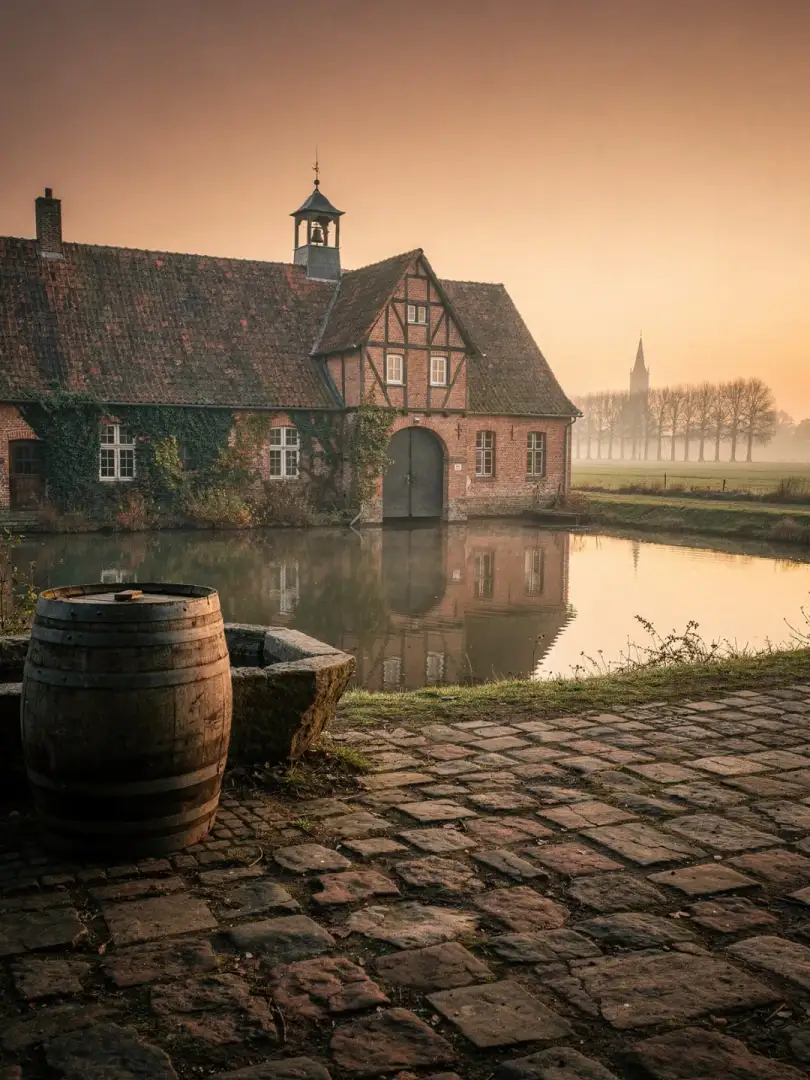
Where does Düsseldorf end, and where does the Lower Rhine begin? There's no sharp line when it comes to Altbier, but there is a clear difference in feel. Here, the copper-colored beer isn't poured in old-town alleys but in village taverns, neighborhood pubs, and family breweries scattered between Neuss, Krefeld, and the Dutch border.
The private brewery Bolten in Korschenbroich reaches back the furthest. It traces its roots to 1266, when the Lord of Myllendonk is said to have granted a certain Heinrich the Brewer permission to brew beer at Kraushof. The company carries the name Bolten because a family member is recorded as owner in 1519. By its own account, it's the oldest Altbier brewery in the world, though that claim is hard to verify from the outside.
Issum, near Geldern, took a different path. In 1878, master brewer Josef Diebels from Krefeld founded his brewery there, and by 1898 it was already producing 10,000 hectoliters a year. Until the early 1970s, the brewery made nearly every style in demand across Germany. Then Diebels committed to a single top-fermented Altbier and became known well beyond the region. The brewery is considered Germany's largest Altbier producer and has been part of Anheuser-Busch InBev since its acquisition in 2001.
Krefeld has kept its own brewing tradition alive. The Gleumes brewery traces its founding to 1807, while Königshof was established in 2003 on a site where beer had once been brewed before. In Mönchengladbach, the Hensen brewery carries on the craft. There's no reliable figure for the whole region, since the Lower Rhine has no administrative boundary of its own.
There's no protected designation of origin for this beer. Unlike Kölsch, Altbier doesn't appear in the EU register of protected geographical indications, and no formal convention like Cologne's is known to exist. The name isn't tied to any one city. The brewers of the Lower Rhine rely instead on their history and their recipes.