Flat Country
Water & Soil
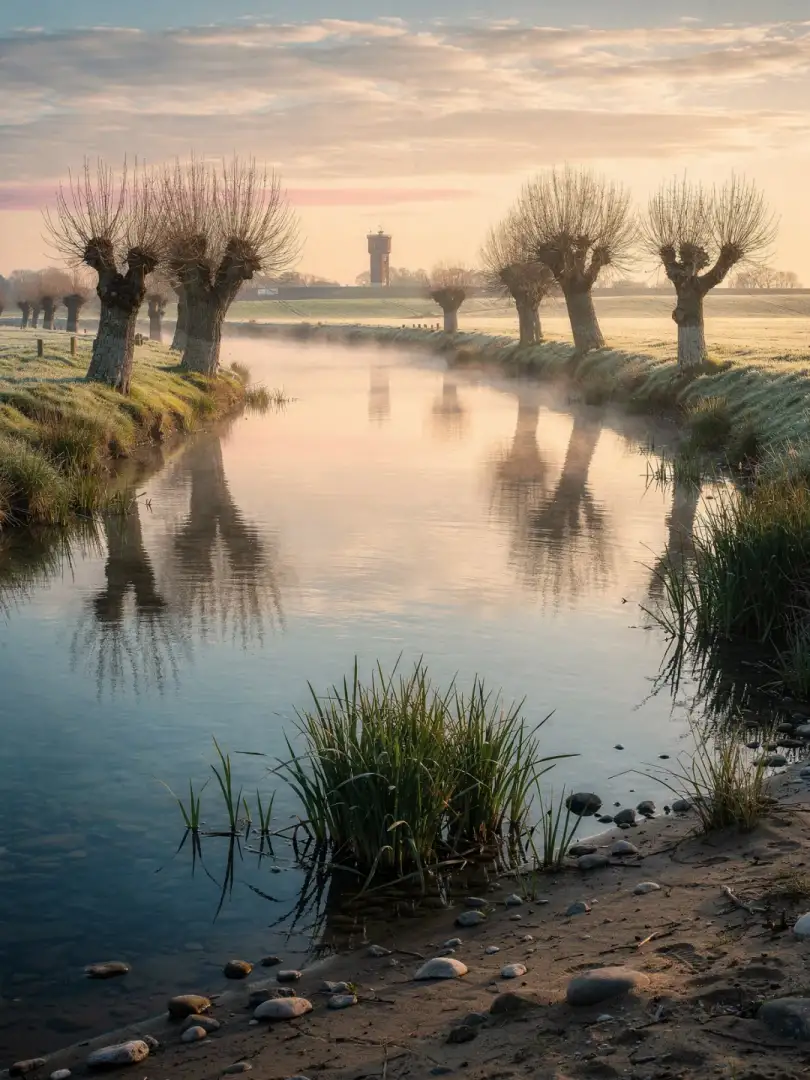
The Lower Rhine lies flat along its river. Over thousands of years, the Rhine and Maas have deposited sand and gravel, smaller streams like the Niers wind between them, and pollarded willows line the edges of the fields. It's the opposite of Franconia: no rock, no cave, no hillside to drive a lagering cellar into.
Brewing water here therefore comes from the groundwater of the plain, filtered through sand and gravel. Whether a brewery draws from its own well or from the municipal supply varies from one operation to the next. Exact hardness values for individual breweries aren't documented, so no figure is given here.
What does water do to beer? Very soft, mineral-poor water lets pale beers like Pils taste clean and hop-forward. Carbonate-rich water, meaning water with plenty of dissolved lime, instead brings out darker malts and suits beers in shades of copper and brown. Today nearly every brewery treats its water, so style is shaped more by the recipe than by the well.
The climate is mild and damp, with the Atlantic not far away. Harsh winters with weeks of frost aren't the norm. For Altbier, that means the cool conditioning phase — when the yeast settles and the beer mellows — happens in chilled tanks and cellars rather than in a rock cave.
Korschenbroich and Issum, the region's two big names, sit out on the flat land rather than in an old town. There was always room there for a brewhouse, storage, and a truck yard. That sets them apart from Düsseldorf's cramped house breweries, whose fermentation cellars sit beneath the taproom.