Red Specialty Malt
Malt & Grain
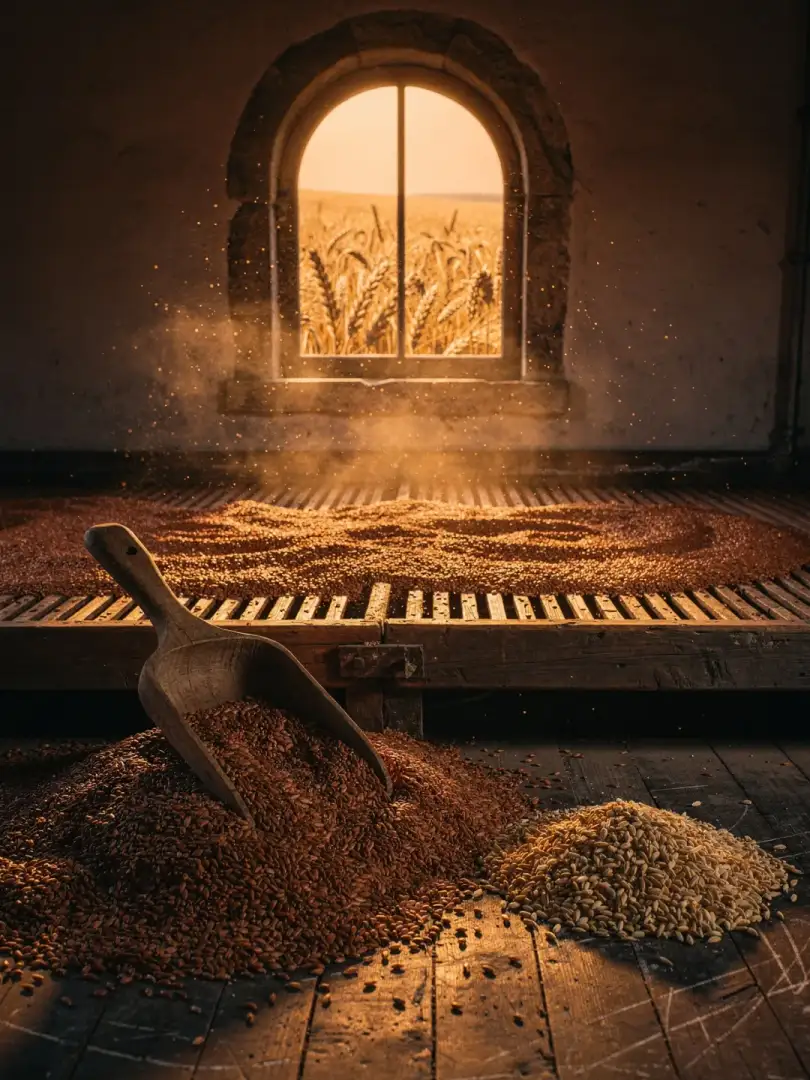
Rotbier owes its color to the malt. Hausbrauerei Altstadthof brews its Original Nürnberger Rotbier, by its own account, from red specialty malt and pale malt, in organic quality. Malt is grain that has been allowed to germinate and is then dried — the kilning process — and the hotter it's kilned, the darker and toastier it becomes.
Between pale and dark lies the middle ground that gives Rotbier its name. A copper to reddish-brown color results when a red specialty malt is blended with a pale malt. No sugar or colorants are needed for this, and in Bavaria they would be prohibited anyway.
Barley has a long legal history in Nuremberg. With the Gerstengebot of 1303 to 1305, the council regulated what beer could be brewed with, and to this day barley malt is considered the foundation of Franconian beer. The Städtisches Weizenbräuhaus of 1672, however, shows that wheat beer was also brewed in the city — and in municipal hands at that.
No single large maltings can be named as representative of both cities. The big breweries buy their malt on the open market, while the smaller houses often work with organic malt from the region.
Tucher illustrates just how closely Nuremberg and Fürth are intertwined. In the new brewhouse, which went into operation in 2008, the city boundary runs right through the facility: the lauter tun and whirlpool stand in Fürth, while the mash tun and wort kettle stand in Nuremberg. In the mash tun, the milled malt is mixed with hot water; in the lauter tun, the wort — the sugar solution — is separated from the spent grains.