Sausage, Cellar, Zoigl
Food & Beer Culture
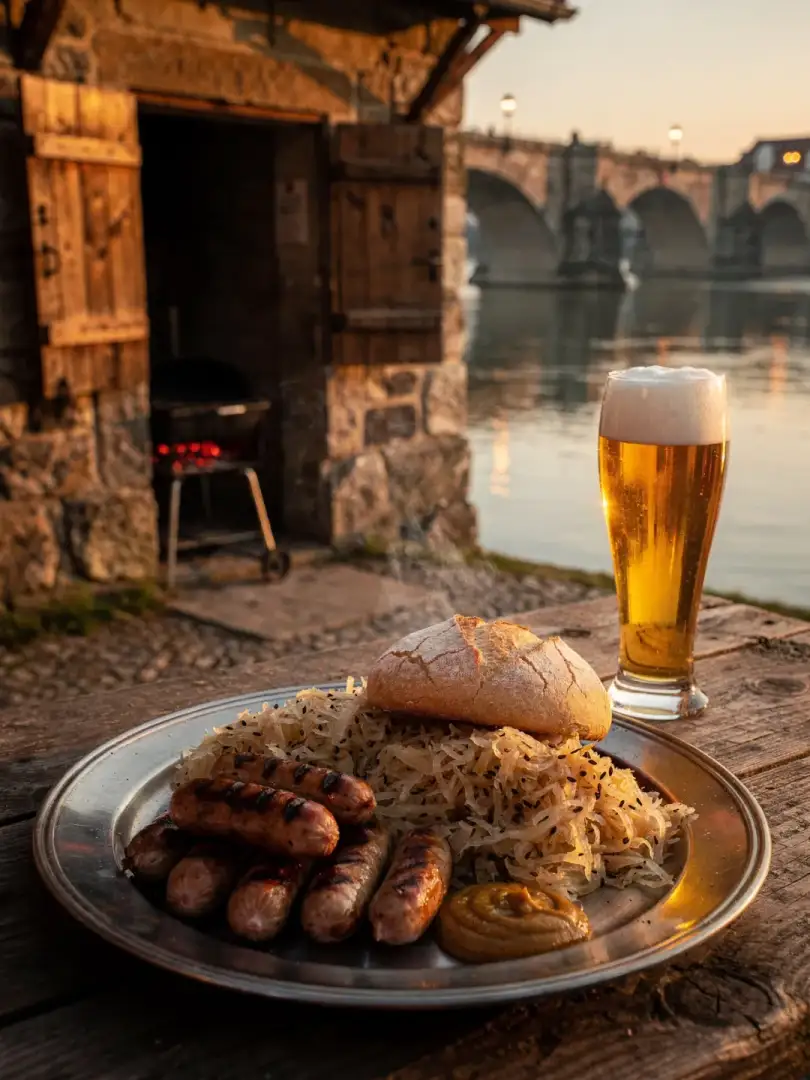
At the southern end of the Stone Bridge stands the Historic Wurstkuchl. It claims to have been grilling bratwurst since 1378, with its history beginning as the construction office for the bridge, which was built between 1135 and 1146. However, a document from Erfurt dated 1269 has called into question its claim to the title of oldest bratwurst kitchen.
On the plate: small bratwursts grilled over charcoal, served with house-fermented sauerkraut and a sweet-and-spicy mustard. The salt and acidity of the sauerkraut strike a fine balance with the mild malt character of a Helles.
In the Kneitinger Keller and the city's beer gardens, a proper Brotzeit is part of the experience: sausage, cheese, lard bread, and radish. Bock and Dunkel pair well with heartier fare like roasts and crispy pork roast, since their malt character complements the roasted flavors.
Beer here is ordered by the Halbe or the Maß, meaning a half-liter or a full liter. In spring and autumn, the Regensburg Dult festival invites visitors to enjoy beer tents and fairground rides.
In the northern Oberpfalz, you'll find Zoigl beer. When a Zoigl inn has beer available, it hangs out the Zoiglstern, a six-pointed star made from the symbols of brewers and maltsters. A Zoigl-Stube is the kind of place where people sit together as a community, share a Brotzeit, and talk.
A Zoigl is typically enjoyed alongside a Brotzeit of sausage, cheese, and bread. Anyone who walks from the Wurstkuchl at the Stone Bridge to the Kneitinger Keller will have experienced two very different sides of Regensburg's beer culture in a single day: the riverside snack stand and the cellar on the hill.