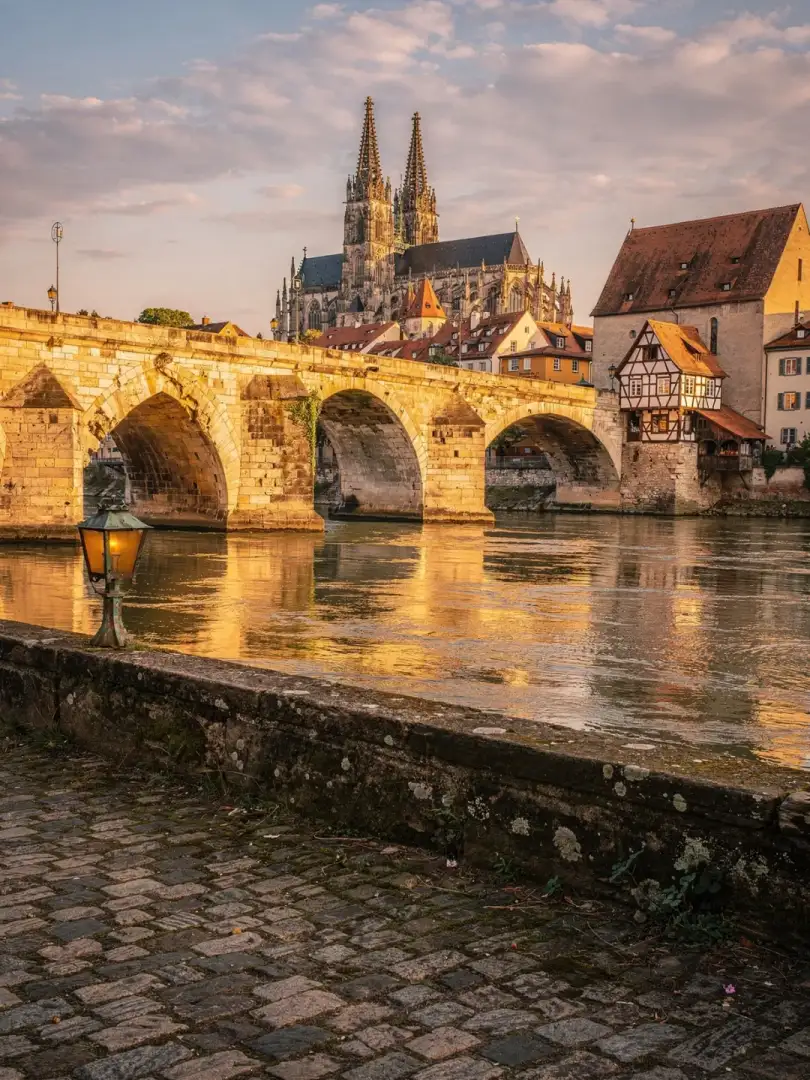
City, Hospital, Bishop
Region & History
Regensburg is among the cities where regulations on what could go into beer already existed in the Middle Ages. A Regensburg ordinance from 1447 predates the Bavarian Purity Law, which wasn't enacted until 1516 in Ingolstadt. The famous law, then, wasn't the first of its kind—it simply applied to a larger territory.
The Spitalbrauerei at Katharinenspital points to a record from 1226 showing that beer was already being brewed there, originally to strengthen the sick. According to the brewery, this makes it the oldest continuously operating brewery in Bavaria. The hospital sits directly on the Danube, right next to the Stone Bridge.
The Bischofshof brewery dates back to 1649 and most recently belonged to a foundation of the Diocese of Regensburg. It long ago moved its site from the cathedral to the city outskirts. The brand will live on, but the brewery itself will not: according to reports from early 2026, production in Regensburg is set to end by late 2026, with Schneider Weisse taking over Bischofshof and Weltenburger on January 1, 2027.
Kneitinger traces its tradition back more than four hundred years. The Kneitinger Keller on the Galgenberg is particularly famous: in 1836 Johann Islinger bought the property, and in 1862 the name Kneitinger entered the picture through marriage. What began as a simple tap room became a piece of city history.
Legally, this falls under Bavarian Beer, protected as a geographical indication since 2001. There is no separate protection for "Regensburg Beer" in the EU register. Meanwhile, up north around Windischeschenbach, the Zoigl tradition of the Oberpfalz lives on.