Basalt and Springs
Water & Soil
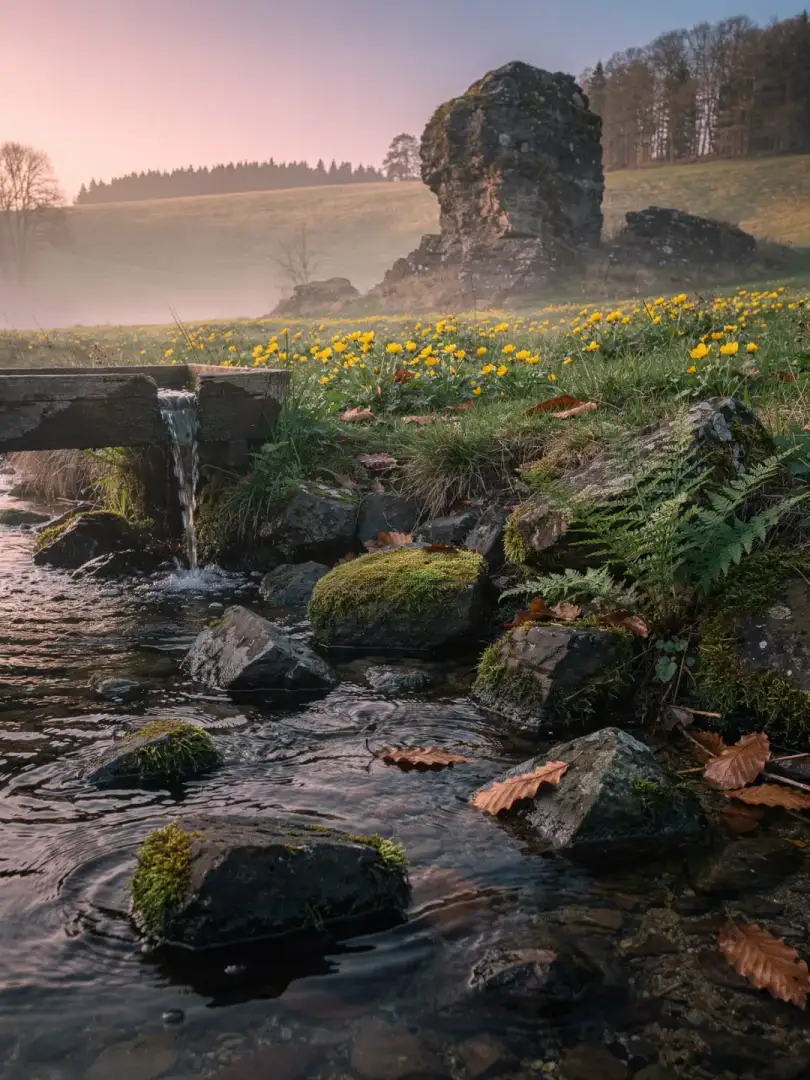
The Rhön is a low mountain range of volcanic origin. Its landscape of basalt domes, high moors and beech forests is known as the “land of open distances,” because the bare heights allow for sweeping views. Rain and snow seep into the mountain here and emerge again as springs. The Fulda river rises at the Wasserkuppe, Hesse’s highest peak at 950 meters, and countless small streams flow down from the slopes around Bischofsheim as well.
How hard the brewing water of a particular brewery is depends on its spring, and there is no single figure for the Rhön as a whole. What is known, though, is where individual breweries source their water: the Rhönbrauerei in Kaltennordheim says it draws from its own deep well within the Biosphere Reserve.
The Rhön Biosphere Reserve has existed since 1991 and spans three German states. For brewers, this mainly means that the catchment area of their springs is protected landscape made up of meadows and forest rather than farmland or industry. Anyone stopping at Kloster Kreuzberg is sitting right in the middle of this spring-fed region.
More important than any water hardness figure these days is water treatment. Almost all breweries now adjust their water deliberately, sometimes softening it, sometimes adding a touch of salt, depending on the beer. The idea that water alone defines a style dates back to a time when no one had access to water treatment.
Terroir also includes climate. At 928 meters, the Kreuzberg is cooler and harsher than the valley below, and snow lingers long into winter. For lagering bottom-fermented beers, that’s an advantage brewers in regions without refrigeration sought out for centuries.