Deep wells and cellars
Water & Soil
The water in the glass today no longer comes simply from the mountains—it's adjusted at the brewery. Nearly every brewery treats its water, softening it or adding specific salts so the brew turns out the same year after year. The old saying that water defines the style is really only true as history now.
In Rosenheim, the story begins in the foothills of the Alps, where the Inn carries water down from the mountains and the Wendelstein peak dominates the skyline. Auerbräu commissioned its own deep well in 1996. Water drawn from such depths changes little over the course of the year, which is an advantage for consistent beer.
What hardness does to beer shows up in the mash, the mixture of milled malt and warm water. Carbonates in the water raise its acidity. Dark malts are naturally acidic themselves and so tolerate hard, carbonate-rich water, the kind associated with Munich. A pale Festbier comes together more easily with softer water, since otherwise the bitterness can turn harsh.
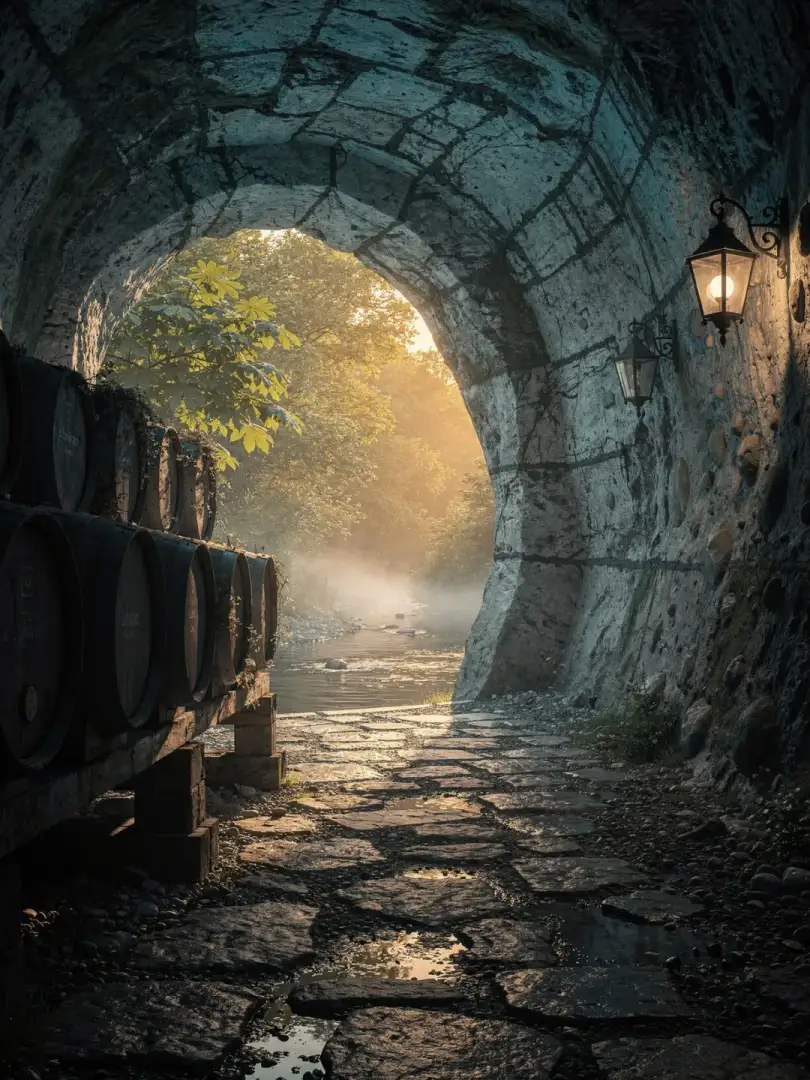
The second water story in the Inn Valley is about cold. Starting in 1785, beer cellars were dug into the hillside along Kellerstrasse in Wasserburg, with expansion continuing into the first half of the 19th century. The reason was an electoral brewing ban in effect from April 23 to September 29. Anyone wanting to serve beer in summer had to brew it in winter and store it cool. Summer beer was therefore brewed stronger and hopped twice as heavily.
The Wasserburg Beer Catacombs are now a museum. The tunnels stay cool year-round, which is exactly why brewers stored their barrels there. A hillside, a tunnel, and cold without electricity: that was the cooling system before refrigeration machines existed.