Loess, Deep Cellars
Water & Soil
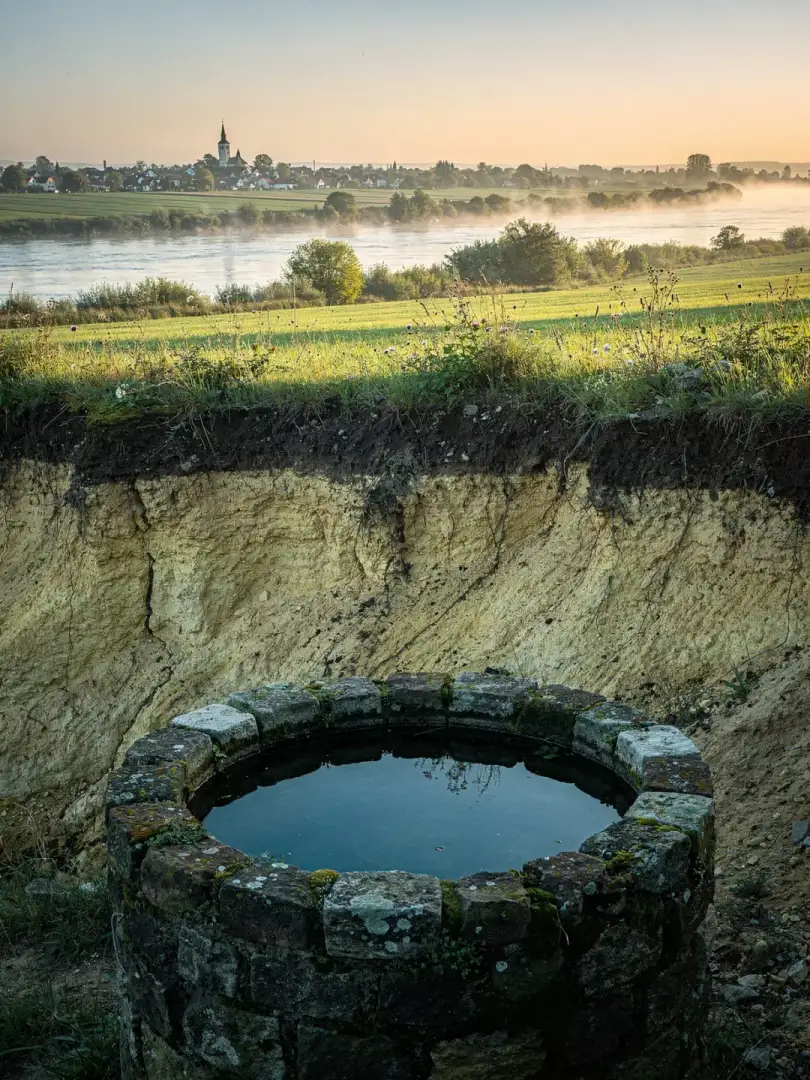
Beneath Straubing lies dust from the Ice Age. Back then, wind deposited it along the edge of the Danube, and to this day it forms a layer some five to six meters thick: loess. From it the dark, deep soils of the Gäuboden developed, ranked among the best in Bavaria. For beer, that's first and foremost a matter of grain, only secondarily of water.
The brewing water itself in Straubing comes from deep underground. Karmeliten Brauerei cites a well roughly 100 meters deep on its own grounds. Deep groundwater stays evenly cool and clean, which is exactly what brewers value: it barely fluctuates throughout the year.
Exactly how hard the water is can't be said for the city as a whole, and we deliberately won't cite specific figures here. What's more, nearly every brewery treats its water today. More important than a number is the question of which beer you want to brew. A pale lager tolerates few dissolved minerals, whereas a dark beer can take more.
A second part of the landscape lies underground. In 1929 Brauerei Röhrl moved its operation to the Sommerkeller on Heerstraße because the deep lagering cellars there were well suited to cool beer storage. Even in August, when the folk festival is in full swing outside, it stays cool down in the cellar. In the old days, beer brewed in winter and spring was stored this way through the summer, since refrigeration machines didn't yet exist.
The Danube flows along the edge of the city, and the flat land of the Gäuboden opens wide on both sides. That's why people here don't talk of beer mountains or rock-cut cellars, but of fields, loess, and deep vaults beneath the city's trees.