Mergers & Family
Region & History
The history of Stuttgart's breweries is above all a history of mergers. Carl Dinkelacker founded his brewery in 1888 right in the heart of the city, while Robert Leicht had launched Schwaben Bräu in Vaihingen back in 1878. Both houses grew during an era when tavern breweries were transforming into industrial operations.
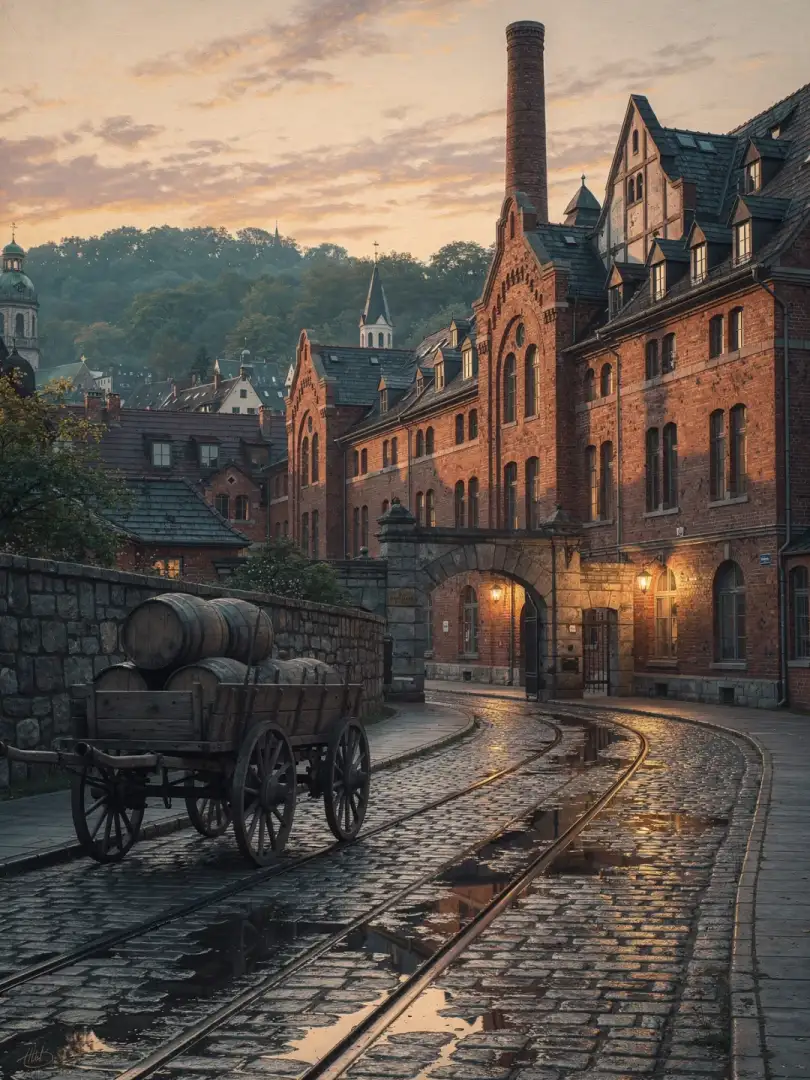
Schwaben Bräu is considered the first German brewery to deliver its beer by Daimler truck, back in 1891. That fits a city that would later become famous as the home of the automobile. A full beer barrel is heavy, and horse-drawn carts quickly reached their limits on the steep streets climbing out of the Kessel basin.
Dinkelacker bought the Stuttgart brewery Wulle in 1971 and the Sanwald brewery in 1977. In 1996, Dinkelacker and Schwaben Bräu merged. Since then, the Schwabenbräu, Wulle, and Sanwald brands have operated under one roof.
In 2004, the brewery was sold to the Interbrew group, which later became AB InBev, the world's largest brewer. In 2007, Wolfgang Dinkelacker, a great-grandson of the founder, bought the company back. Since then, it has once again been a family-owned brewery.
Alongside Dinkelacker-Schwaben Bräu stands the city's second major brewery, Stuttgarter Hofbräu, based in the Süd district. Together, the two shape the beer served across Stuttgart, from neighborhood pubs to the Volksfest.
There is no protected designation of origin for Stuttgart beer. No beer from Württemberg appears in the EU register, and the Reinheitsgebot of 1516 applied only within the Duchy of Bavaria. As across Germany today, what can be sold as beer is governed by the Bierverordnung (Beer Ordinance) and the still-applicable parts of the Provisional Beer Law.