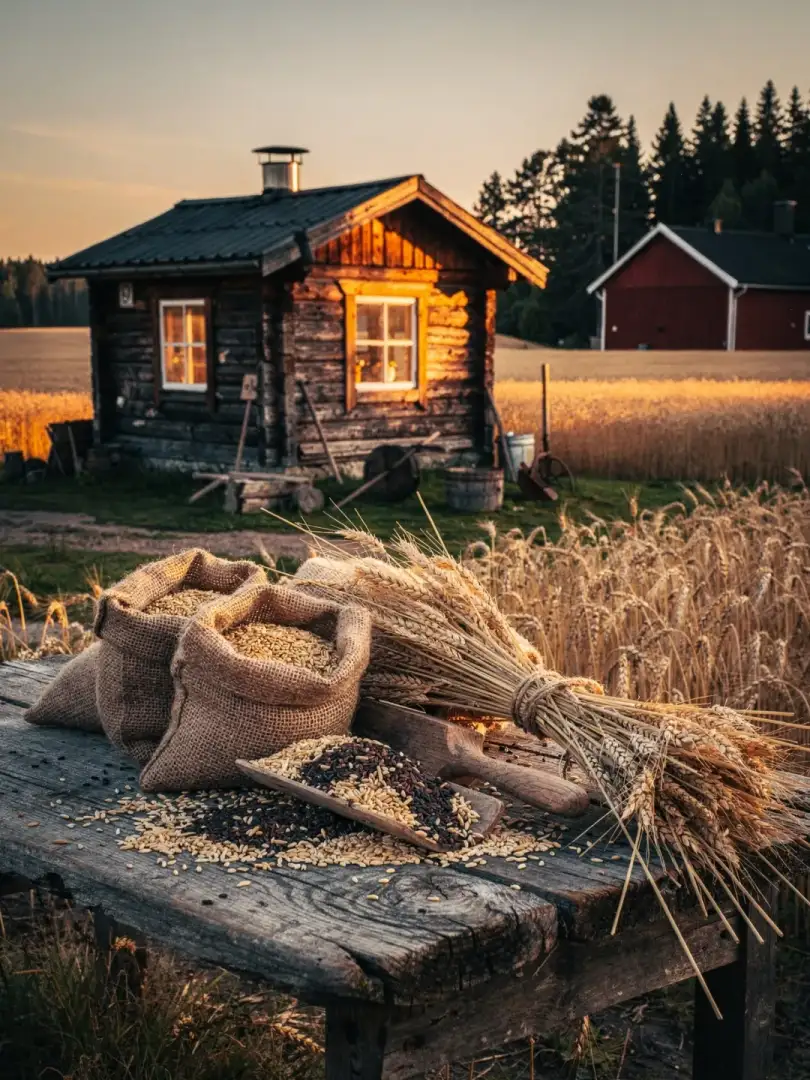
Barley, Rye, Straw
Malt & Grain
What grain is Sahti brewed from? At its core, barley and rye, both grains that thrive in Finland's climate. Added to this is barley malt, meaning barley that's been allowed to germinate and then dried, so its starch can later be converted into sugar. Depending on the farm, unmalted grain also goes into the pot, such as rye or oats.
What makes Sahti distinctive is the sheer quantity. The BJCP style guidelines, a reference used in beer competitions, cite original gravity values of roughly 18 to 28 degrees Plato. For comparison, a Pilsner sits around 11 to 12. So a great deal of grain goes into very little beer, and you can taste that in the sweetness.
In the old days, the malt was dried on the farm. According to tradition, this was sometimes done in the sauna, which stood on every Finnish farm. This often gave the malt a hint of smoke. How strong that smokiness was in practice varied from farm to farm; there's no fixed smoke standard.
The most important tool for mashing is a wooden trough, the kuurna. Straw and juniper branches lie at the bottom, and the mash is poured over them. The mixture acts like a sieve, holding back the grain solids. The wort, the sugary liquid, drains out through a hole at the bottom.
A special variant survives in some households: Kivisahti, meaning stone Sahti. Here, the wort is heated with red-hot stones placed in the trough instead of being boiled in a kettle. This gives the beer a slightly caramelized, sometimes smoky note. One producer of this style, Hollolan Hirvi, is located in southern Häme.