Pasteur's Discovery
Yeast & Fermentation
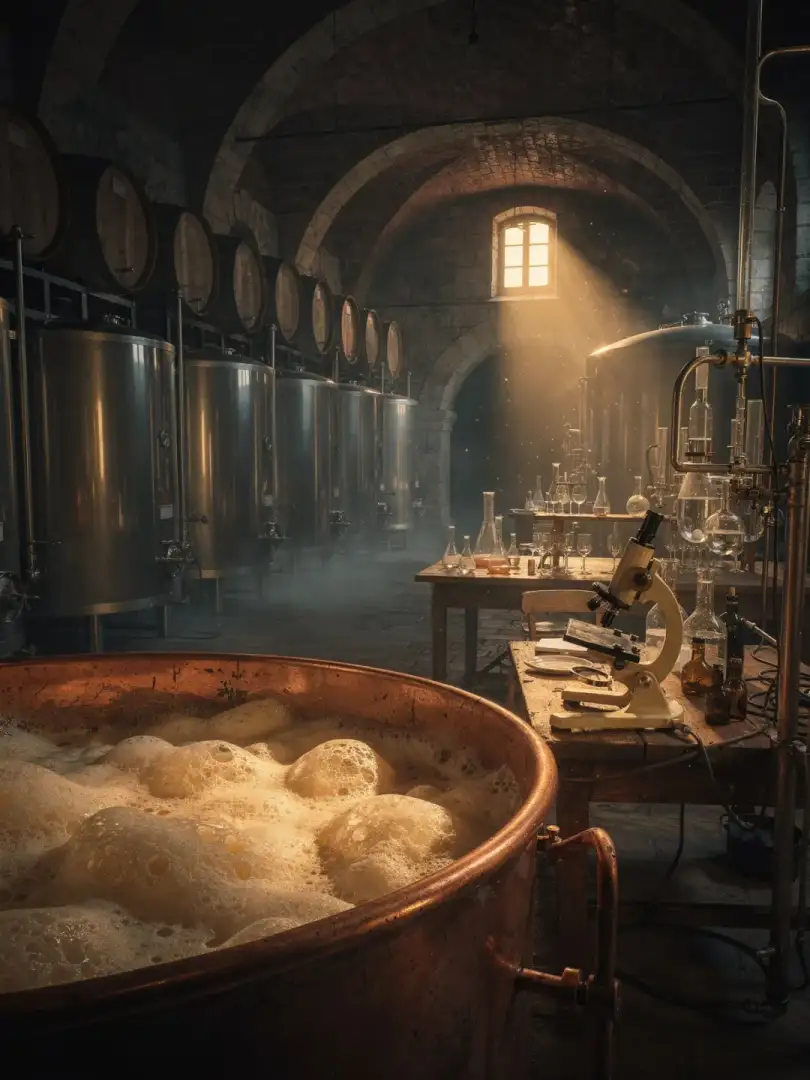
Why does beer turn sour, and how do you keep it fresh? This question drove Louis Pasteur to Lorraine. For his "Études sur la bière," he studied, in Clermont-Ferrand, in Paris, and at the Tourtel brothers' brewery in Tantonville, how yeast works and which microorganisms spoil beer.
Pasteur described an improved method for cultivating pure yeast. He also showed that yeast occasionally needs tiny amounts of oxygen to stay young and fermentation-ready. The title of the book, after all, promises a method for making beer imperishable.
When people say "yeast," they mean the microbes that convert malt sugar into alcohol and carbon dioxide. Later came Emil Christian Hansen, who in 1883 at the Carlsberg laboratory in Copenhagen obtained the first pure culture of a bottom-fermenting yeast.
Bottom-fermenting means the yeast sinks to the bottom at the end of fermentation and works at cool temperatures, typically around ten degrees Celsius. The result is a clear, clean beer without fruity off-notes. It then lagers cold, often for several weeks.
The brewery museum in Saint-Nicolas-de-Port has preserved an old laboratory. Seeing it, you understand just how closely research and craft were intertwined in this region.
Without Pasteur and Hansen, breweries would still be at the mercy of chance today. Pure-culture yeast ensures that every batch tastes the same, and it was precisely this consistency that made large-scale breweries like Champigneulles possible in the first place. So when you drink a beer from this region today, you're also tasting a piece of scientific history that began in Tantonville.